What Is Nanomedicine?
Nanomedicine is the use of nanotechnology in healthcare. Nanotechnology involves working with materials and devices measured in nanometers (nm). One nanometer is one billionth of a meter, or about 0.000000039 inches. At this incredibly small size, scientists can interact with individual cells, viruses, proteins, and even DNA molecules.
Nanomedicine combines biology, chemistry, medicine, engineering, physics, and artificial intelligence to improve the way diseases are diagnosed, treated, and prevented. Although many nanomedicine technologies are still being researched, some are already helping doctors treat patients today.
Why Does Size Matter?
The human body is made of microscopic building blocks. Cells are only a few thousand nanometers across, bacteria are even smaller, and many viruses measure only a few dozen nanometers in diameter.
Traditional medicines travel throughout the entire body, meaning healthy tissues are often exposed to the same drugs that are intended to treat diseased areas. This can cause unwanted side effects.
Nanomedicine allows scientists to create particles that are similar in size to many biological structures. Because of their small size, these particles can interact with cells much more precisely than many conventional treatments. This precision is one of the biggest advantages of nanomedicine.
Nanoparticles: Tiny Medicine Carriers
One of the most successful areas of nanomedicine involves nanoparticles.
Nanoparticles are extremely small particles engineered to carry medicines safely through the body. Scientists can design nanoparticles that protect fragile medicines until they reach their destination. Once they arrive at the correct tissue, they release the medicine exactly where it is needed.
This targeted drug delivery reduces the amount of medicine affecting healthy cells while increasing the amount reaching diseased tissue. Several nanoparticle-based medicines are already approved for treating certain types of cancer and other diseases.
Fighting Cancer
Cancer treatment is one of the biggest areas of nanomedicine research. Chemotherapy drugs often affect both cancer cells and healthy cells, producing side effects such as hair loss, nausea, and fatigue.
Researchers are developing nanoparticles that recognize specific proteins found on cancer cells. Once attached, they release chemotherapy drugs directly into the tumor while reducing exposure to healthy tissues.
Scientists are also investigating nanoparticles that respond to heat, light, magnetic fields, or changes in acidity, allowing doctors to activate treatments only where they are needed.
Although researchers continue improving these technologies, targeted nanomedicine is already making some cancer treatments more effective.
Early Disease Detection
Finding diseases early often makes treatment much more successful.
Scientists are developing nanosensors capable of detecting extremely small amounts of biological molecules called biomarkers. Biomarkers are substances produced by healthy or diseased cells. Some biomarkers appear in the bloodstream long before symptoms develop.
Future nanosensors may detect cancers, infections, heart disease, or neurological disorders months—or even years—earlier than many current diagnostic methods. Earlier diagnosis could allow doctors to begin treatment before serious damage occurs.
Medical Imaging
Nanotechnology is also improving medical imaging. Special nanoparticles can be designed to attach to tumors, blood vessels, or specific organs. During an MRI, CT scan, PET scan, or other imaging procedure, these particles make important structures easier to see.
Researchers are creating contrast agents that produce clearer images while requiring smaller amounts of material than traditional imaging compounds. Future imaging systems may combine nanotechnology with artificial intelligence to detect diseases that are currently difficult to identify during their earliest stages.
Artificial Intelligence and Nanomedicine
Artificial intelligence (AI) is becoming an important partner in nanomedicine. Designing nanoparticles requires understanding millions of possible combinations of materials, shapes, sizes, and chemical coatings.
AI can analyze enormous datasets and predict which nanoparticle designs are most likely to succeed before laboratory testing even begins. Machine learning also helps researchers understand how nanoparticles move through the body, interact with cells, and respond to different diseases.
By combining AI with nanotechnology, scientists can develop new treatments much faster than ever before.
Regenerative Medicine
Nanomedicine is also contributing to regenerative medicine. Scientists are creating nanoscale materials that encourage damaged tissues to heal more effectively. These materials can act as tiny scaffolds that guide the growth of new cells while supporting tissue repair.
Researchers hope to use nanotechnology to regenerate bone, cartilage, skin, blood vessels, and nerve tissue after injuries. Combined with stem cells and 3D bioprinting, nanomedicine may eventually help repair organs that are currently difficult or impossible to heal.
Fighting Infections
Nanotechnology may also help combat dangerous bacteria and viruses. Researchers are developing nanoparticles that destroy bacteria without harming healthy cells. Some nanoparticles physically damage bacterial cell walls, while others deliver antibiotics directly to infected tissues.
Scientists are also studying antiviral nanoparticles that interfere with how viruses enter cells or reproduce. As antibiotic resistance becomes a growing global problem, nanomedicine may provide valuable new treatment options.
Smart Drug Delivery
Future medicines may become much smarter than today’s pills. Instead of releasing medicine immediately after entering the body, smart nanoparticles could wait until they reach a specific organ or detect certain chemical signals.
Some experimental systems release medicine only when exposed to light, heat, magnetic fields, ultrasound, or changes in pH. This controlled drug delivery could improve treatment effectiveness while reducing side effects.
Researchers continue testing these technologies in laboratories and clinical studies.
Nanorobots: Science Fact or Science Fiction?
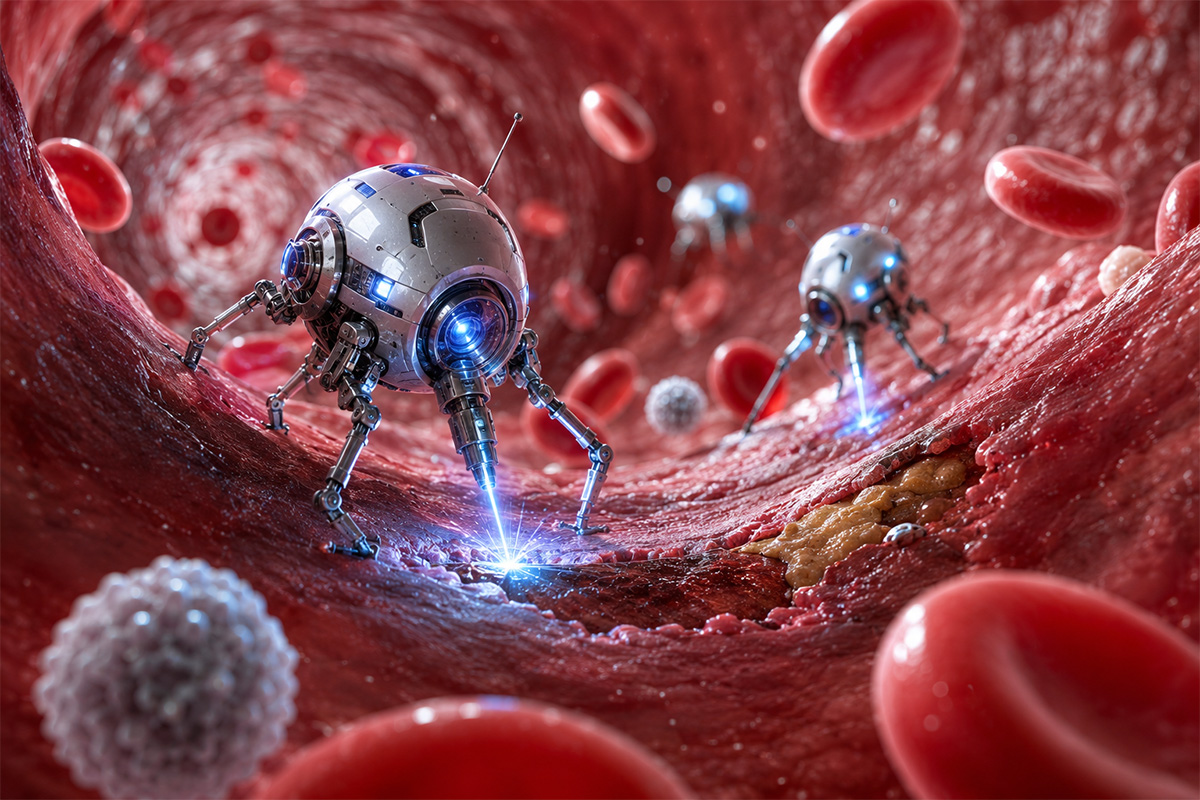
One of the most exciting ideas in nanomedicine is the development of medical nanorobots. These microscopic machines, possibly biological, could someday travel through the bloodstream performing tasks such as delivering medicine, repairing damaged tissues, clearing blocked arteries, or destroying cancer cells.
Some researchers also imagine nanorobots monitoring blood chemistry continuously and identifying diseases before symptoms appear. Although simple microscopic machines are already being developed for specialized laboratory applications, fully autonomous medical nanorobots capable of performing complex procedures inside the human body do not yet exist.
Developing such devices presents enormous engineering and biological challenges, making this one of the most ambitious goals in nanomedicine.
Personalized Medicine
Every person’s body responds differently to medicines. Future nanomedicine may allow doctors to create treatments specifically designed for each patient.
Artificial intelligence could combine genetic information, medical history, laboratory tests, and imaging results to determine which nanoparticles, medicines, and treatment strategies would work best for each individual.
This personalized approach may improve treatment effectiveness while reducing unwanted side effects.
Challenges and Safety
Although nanomedicine has enormous potential, important challenges remain.
Scientists must carefully study how nanoparticles interact with living tissues over long periods.
Because nanoparticles are much smaller than ordinary materials, they may behave differently inside the body.
Researchers also need to ensure that nanoparticles are safely removed after completing their medical tasks.
Manufacturing highly specialized nanoparticles requires advanced equipment and strict quality control, making some treatments expensive.
Governments carefully regulate new nanomedicine technologies to ensure they are both safe and effective before they become widely available.
The Future of Nanomedicine
The future of nanomedicine could transform healthcare.
Researchers hope to develop microscopic systems capable of continuously monitoring health, detecting diseases at their earliest stages, and delivering treatments automatically.
Artificial intelligence may design entirely new nanoparticle medicines in weeks instead of years.
Medical imaging may become more accurate using nanoscale contrast agents that reveal diseases before symptoms develop.
Scientists are also exploring combinations of nanomedicine with regenerative medicine, gene therapy, robotic surgery, wearable health sensors, and brain-computer interfaces.
Although many of these technologies remain under development, they represent some of the most exciting areas of medical research.
Nanomedicine is changing the way scientists think about healthcare. By working at the scale of cells and molecules, researchers are developing smarter medicines, earlier disease detection, more accurate medical imaging, improved regenerative therapies, and highly targeted treatments that were impossible only a few decades ago.
Some nanomedicine technologies are already helping patients today, while others—including advanced medical nanorobots—remain ambitious goals for the future. As artificial intelligence, biotechnology, medical imaging, and nanotechnology continue advancing together, nanomedicine may become one of the most important healthcare technologies of the twenty-first century.