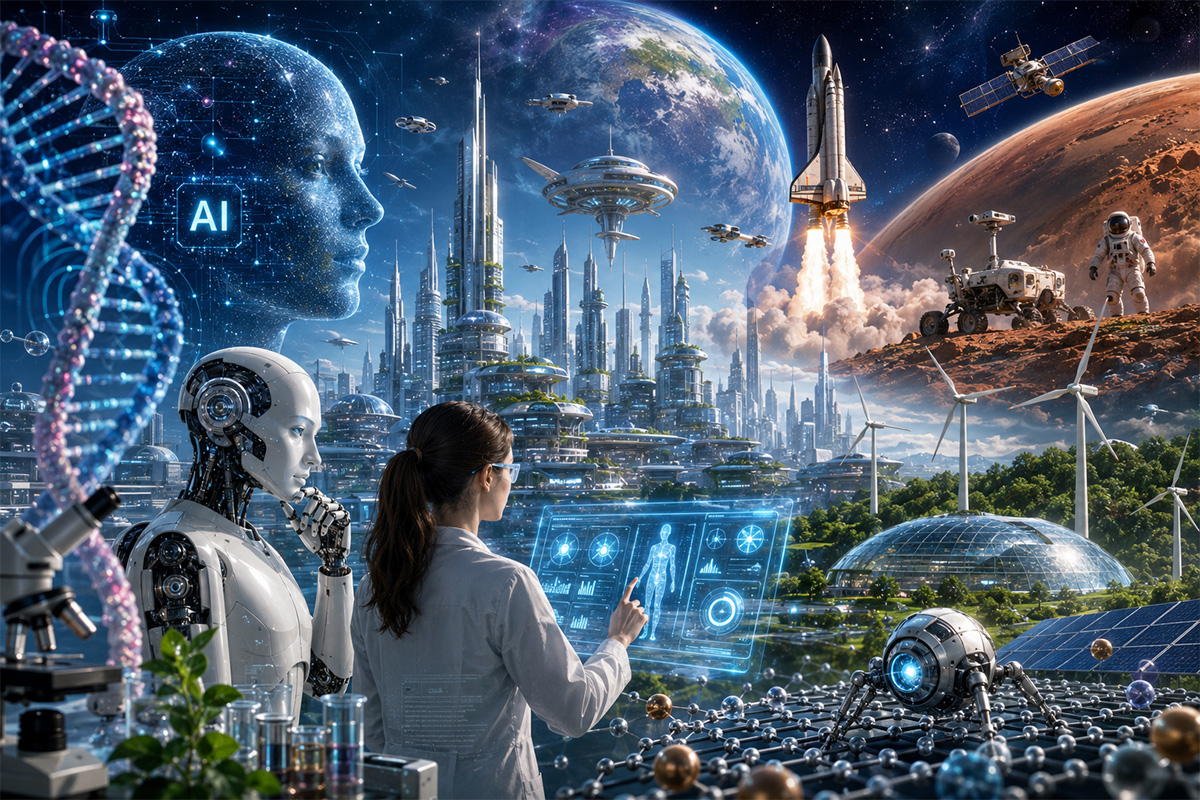
Technology Is Changing Faster Than Ever
Imagine trying to explain today’s world to someone living 150 years ago. You might tell them that billions of people carry pocket-sized computers, doctors can see inside the human body without surgery, robots explore Mars, machines can generate pictures and conversations, and a video call can connect people on opposite sides of Earth almost instantly.
To us, these technologies are becoming ordinary.
Now imagine trying to predict the world 50 or 100 years from today.
Some technologies that will shape that world are already being developed. Artificial intelligence is making computers more capable. Robots are learning to operate outside factories. Scientists can manipulate matter at extremely small scales, while biotechnology and chemistry are producing new medicines and materials. Virtual and augmented reality are changing how we interact with digital information, and increasingly capable spacecraft are expanding our reach into the Solar System.
Other technologies of the future may depend on discoveries that haven’t been made yet.
The future will probably not be defined by one great invention. Instead, many technologies will increasingly connect and combine with one another. AI could control robots, nanotechnology could improve medical imaging, augmented reality could display information collected by Internet-connected sensors, and 3D printers could manufacture objects designed by intelligent computers.
Let’s explore some of the technologies that could help shape that future.
3D Printing
Traditional manufacturing often starts with a block or sheet of material that is cut, drilled, bent, molded, or machined into the desired shape. 3D printing, also called additive manufacturing, approaches the problem differently. A digital model is divided into extremely thin layers, and a machine builds the physical object one layer at a time.
Consumer 3D printers commonly melt plastic filament and deposit it through a moving nozzle. Industrial printers can work with metals, ceramics, polymers, concrete, and other materials. Because a 3D printer follows a digital design, it can manufacture complicated shapes that would be difficult or expensive to produce with conventional techniques.
Future 3D printers could become faster, more precise, and capable of working with a much wider variety of materials. Factories might use networks of automated printers to manufacture customized products on demand rather than producing enormous inventories of identical items.
Replacement parts could be downloaded and manufactured locally instead of being shipped halfway around the world. Construction-scale printers can already deposit concrete-like materials. Future systems could help construct houses, bridges, and other structures with less material waste.
Space exploration presents another interesting application. Instead of launching every replacement part from Earth, astronauts could manufacture some tools and components when needed. Eventually, robots could use local lunar or Martian materials to help construct structures before astronauts arrive.
One of the most interesting forms of additive manufacturing is 3D bioprinting. Rather than depositing plastic or metal, a bioprinter can precisely position cells and biomaterials.
Augmented Reality
Augmented reality, or AR, combines digital information with our view of the physical world. Unlike virtual reality, AR does not necessarily replace your surroundings. It adds to them.
A technician repairing an engine might see arrows showing which bolts to remove. A student studying anatomy could see a three-dimensional heart floating above a desk. A tourist could look at a historic building and immediately see information about its history.
Today’s AR commonly appears through smartphones and specialized headsets. Future augmented reality could become much more natural. Eventually, lightweight AR glasses could perform many jobs currently handled by smartphones. Instead of constantly looking down at a rectangular screen, digital information could appear wherever it is useful.
Virtual Reality
While augmented reality adds digital objects to the real world, virtual reality, or VR, attempts to replace your visual surroundings with a computer-generated environment.
A VR headset places displays in front of the eyes and continuously updates the images as the user’s head moves. Modern systems can also track controllers, hands, eyes, and sometimes the user’s body. The result creates a sense of being present inside a digital environment.
Future VR headsets could become smaller, lighter, and more comfortable while providing wider fields of view and displays with resolutions high enough that individual pixels become extremely difficult to see.
Imaging Technology
Many of science’s greatest advances came from finding new ways to see. Microscopes revealed cells and microorganisms. Telescopes revealed distant galaxies. X-rays allowed doctors to see bones without surgery. Modern imaging technology goes far beyond ordinary photography.
Magnetic resonance imaging, or MRI, can create detailed images of internal anatomy. Computed tomography, or CT, combines many X-ray measurements to reconstruct cross-sectional views of the body. Ultrasound uses high-frequency sound waves, while PET imaging can reveal biological activity using radioactive tracers.
Electron microscopes can reveal structures far smaller than those visible with conventional optical microscopes.
Chemistry
Chemistry may not immediately sound like a futuristic technology, but nearly every advanced device depends on it. Chemistry studies matter—what substances are made of, their properties, and how they interact and change.
Batteries depend on electrochemistry. Semiconductor manufacturing requires extremely precise chemical processes. Medicines are made from molecules whose structures determine how they interact with the body.
Solar cells, plastics, fuels, fertilizers, displays, paints, adhesives, and thousands of other technologies depend on chemistry. Future chemists could develop materials with properties that seem extraordinary today.
Nanotechnology
Nanotechnology involves studying and controlling matter at scales generally measured in nanometers. At these sizes, materials can behave differently because quantum effects and surface interactions become increasingly important. Nanotechnology is already used in electronics, coatings, medicine, materials, and manufacturing.
Modern computer chips contain features measured in nanometers, while nanoparticles can have optical, electrical, chemical, or mechanical properties different from larger pieces of the same material.
Nanomedicine
Medicine could become one of nanotechnology’s most important applications. Nanoparticles can be engineered to carry medicines through the body. Researchers can modify their surfaces and physical properties to influence where they travel and how they interact with cells.
Future nanomedicine delivery systems could release medicine at particular locations or under specific biological conditions. Future medicine could combine nanoparticles, engineered biological molecules, nanoscale sensors, and microscopic machines in increasingly sophisticated ways.
Computers
Computers have transformed almost every part of modern society. For decades, much of their improvement came from placing increasing numbers of smaller transistors onto computer chips. That progress continues, but future computing will probably involve much more than simply making conventional processors faster.
Different computing architectures are being developed for different problems. Graphics processing units, or GPUs, became important for AI because they can perform many mathematical operations in parallel. Specialized AI accelerators take this idea even further.
Future computers could combine traditional processors with AI processors, photonic components, neuromorphic chips, and possibly quantum processors.
Communication
Communication technology has progressed from writing and printing to telegraphs, telephones, radio, television, satellites, fiber optics, smartphones, and the Internet. Today, information can travel around the world almost instantly. Future communication could make distance matter even less.
Advanced satellite networks could bring broadband Internet access to locations that are difficult to reach with terrestrial infrastructure. Fiber-optic networks will continue carrying enormous quantities of information using pulses of light. Future wireless systems could provide greater bandwidth and connect huge numbers of machines.
Improved AI translation could make education, international collaboration, travel, and scientific knowledge more accessible.
Internet of Things
The Internet of Things, or IoT, connects physical objects to digital networks.
A smart thermostat can measure temperature and communicate with other devices. Factory equipment can report vibration and temperature measurements. Agricultural sensors can measure soil moisture.
Billions of connected devices can collectively provide a detailed picture of the physical world. Future cities could contain networks of sensors monitoring traffic, air quality, water systems, electricity use, buildings, and infrastructure.
Future IoT devices could become extremely small and inexpensive. Sensors could be built into roads, bridges, clothing, appliances, vehicles, farms, factories, and packaging. A bridge might continuously monitor its own structural condition. Food packaging could provide better information about freshness. A water network could identify leaks automatically.
Drones
A drone is an aircraft that operates without a pilot physically aboard. Modern drones range from tiny quadcopters to large fixed-wing aircraft. Many contain cameras, GPS receivers, inertial measurement units, flight controllers, radios, electric motors, and other sensors.
AI is giving drones increasing levels of autonomy. Instead of requiring a pilot to control every movement, advanced systems can follow routes, avoid some obstacles, recognize objects, and complete portions of missions automatically.
Drones could become important tools for agriculture, infrastructure inspection, emergency response, environmental monitoring, mapping, and transportation.
Robotics
Industrial robots have manufactured products for decades, but they usually work inside carefully controlled environments. The future of robotics is about bringing machines into the unpredictable human world.
A home contains stairs, furniture, pets, dishes, clothing, doors, and objects that constantly move. A robot needs sensors to understand this environment, AI to interpret what it sees, and sophisticated control systems to move safely through it. Recent advances in AI are helping robots learn more general skills instead of following only rigidly programmed movements.
Humanoid robots are particularly interesting because the world was built for human bodies. Door handles are positioned for human hands. Stairs are designed for human legs. Tools, shelves, kitchens, vehicles, and workplaces have human proportions. A robot with roughly human arms, hands, and legs could potentially use existing environments without requiring everything to be redesigned.
The greatest challenge may not be making a robot walk. It is creating a machine that can understand unfamiliar situations and reliably behave safely around people.
Exoskeletons
Instead of building a robot that replaces a person, what if we build a robot that works with the human body? An exoskeleton is a wearable structure designed to support or assist movement.
Some exoskeletons are passive and use springs or mechanical structures to redistribute forces. Powered exoskeletons can use electric motors, hydraulic systems, sensors, and computers to actively assist movement.
Industrial exoskeletons can reduce strain during repetitive work. Medical exoskeletons can help some people with mobility impairments stand or walk during rehabilitation.
Space Exploration
For most of history, humans were limited to Earth’s surface. In the twentieth century, we began sending machines—and eventually people—beyond it. The twenty-first century could bring a major expansion of space exploration.
Reusable rockets can reduce the cost of reaching orbit. More capable robotic spacecraft can explore distant worlds, while powerful space telescopes study planets around other stars.
Future missions could establish long-term human facilities on the Moon and eventually send astronauts to Mars.
Five of the Scariest Future Technologies
Future technology offers enormous benefits, but powerful tools can also create new dangers. Scary does not necessarily mean that a technology is bad. Fire, electricity, automobiles, aircraft, and the Internet all create risks while providing enormous benefits. The challenge is making sure technological capability grows alongside our ability to use it responsibly.
These five scary future technologies deserve particular attention.
Future Technology Predictions
Predicting the future is never easy. Some technologies develop much faster than expected, while others take decades longer than scientists originally imagined. The future will not be shaped by technology alone. It will also depend on the choices we make about ethics, education, environmental protection, and how we decide to use these powerful new tools.
Although nobody can predict the future with certainty, current scientific research gives us clues about what may be coming next. Some of these future technology predictions will probably be wrong. Others may happen much sooner than expected.
The Biggest Invention May Not Exist Yet
There is an important problem with every prediction about future technology. We naturally predict the future using things that already exist.
Someone living in 1900 could imagine faster trains, bigger ships, and improved telephones. Predicting smartphones, GPS navigation, gene editing, social media, nuclear power, and artificial intelligence would have been much harder.
The same limitation applies to us.
Some of the most important technologies of 2100 may depend on scientific discoveries that nobody has made yet.
Perhaps physicists will discover new properties of matter. Chemists may create materials with unexpected abilities. Biologists could uncover fundamental principles of living systems that lead to entirely new technologies.
The biggest breakthrough of the twenty-first century could currently be nothing more than a question in the mind of a student.
Technologies Will Converge
One of the most important future trends may be technological convergence. Technologies that develop separately can eventually combine and become much more powerful.
Consider a future rescue robot. The machine could have a body manufactured with advanced 3D printing. Nanomaterials could make it lighter and stronger. Cameras and imaging sensors would allow it to see. AI would interpret those images and control its movements. IoT networks would allow the robot to communicate with buildings, drones, and emergency workers.
Drones could map the disaster area from above. A rescue worker wearing AR glasses could see information gathered by all these systems, while an exoskeleton helps them move heavy debris. Satellite communication could connect the entire operation with specialists thousands of miles away.
None of those technologies needs to work alone.
Together, they create something much more capable.
How Technology Could Change Education
Future technology could dramatically change how students learn.
AI tutors could provide personalized explanations and exercises. Augmented reality could place three-dimensional scientific models directly into classrooms. Students studying chemistry might manipulate virtual molecules with their hands.
VR could transport a class to ancient Rome, the International Space Station, the bottom of the ocean, or inside a human cell. Low-cost microscopes, sensors, robots, and 3D printers could allow students to conduct experiments and manufacture their own designs.
Automatic translation could make educational resources available across language barriers. However, technology should support learning rather than replace thinking.
In a world where AI can instantly generate an answer, knowing how to ask questions, investigate evidence, recognize errors, and think critically may become more important than ever.
How Technology Could Change Work
Automation will continue changing employment.
Robots can perform physical tasks, while AI can automate some forms of intellectual work.
This does not necessarily mean that every occupation disappears.
Most jobs contain many different tasks. Technology may automate some while making people more productive at others.
A construction worker could use an exoskeleton. A doctor might use AI and advanced imaging. A farmer could manage autonomous tractors and drones. An engineer might work with an AI system and 3D printer to create prototypes in hours instead of weeks.
New careers will also appear.
Someone needs to design, manufacture, operate, maintain, regulate, and improve all these technologies.
The difficult part is making sure people have opportunities to learn new skills as the economy changes.
Technology and Inequality
A technology can exist without being equally available. A student with fast Internet access, a modern computer, and an AI tutor has opportunities that a student without reliable electricity or Internet access does not.
The same problem applies to advanced medicine, clean water, transportation, education, and energy. As technology becomes more powerful, accessibility and affordability will become increasingly important.
A $1 million medical invention that saves lives is scientifically impressive. A version inexpensive enough to reach millions of people could have a much larger social impact.
The future of technology should therefore be measured not only by what machines can accomplish but by how many people benefit from them.
Technology and Privacy
Future devices will generate enormous amounts of information.
AR glasses may contain cameras. Smart homes will contain sensors. Wearables could collect health measurements, while connected vehicles record information about transportation.
AI can analyze these enormous datasets and discover patterns that would be difficult for humans to recognize.
This creates useful services, but it also creates opportunities for surveillance and manipulation.
Future privacy may depend on stronger encryption, better cybersecurity, improved regulations, and technologies that allow information to be processed without unnecessarily revealing personal data.
Students growing up today may eventually help determine what privacy means in a world filled with intelligent machines.
Technology and the Environment
Future technology will also affect the planet. Renewable energy, smart electrical grids, improved batteries, precision agriculture, water recycling, electric transportation, and new materials could reduce some environmental impacts. Satellites, drones, sensors, and AI can monitor forests, oceans, wildlife, pollution, crops, and climate change.
But technology itself requires resources. Computer chips require highly specialized materials and manufacturing. Batteries require minerals. Data centers consume electricity and water. Electronic waste creates environmental problems.
The goal should therefore not simply be more technology. It should be technology that accomplishes useful things efficiently, lasts longer, can be repaired or recycled, and produces fewer unwanted environmental effects.
Should We Be Excited or Worried?
Both reactions are understandable.
Robotics can remove people from dangerous workplaces, but automation can disrupt employment.
AI can provide personalized education, but it can also create convincing misinformation.
Drones can search for disaster survivors, but similar technologies can become weapons.
Biotechnology can cure diseases, while the same knowledge can create biological risks.
IoT sensors can make cities more efficient while creating new privacy problems.
Technology itself rarely determines which future we get.
People do.
Scientists and engineers determine how systems are designed. Businesses decide how products are deployed. Governments establish laws and regulations. Communities decide what technologies they will accept, and individuals make choices about how they use them.
That makes understanding technology important even for people who never become scientists or engineers.
What we can do is understand the technologies being developed today, think carefully about their benefits and risks, and make decisions about how they should be used.