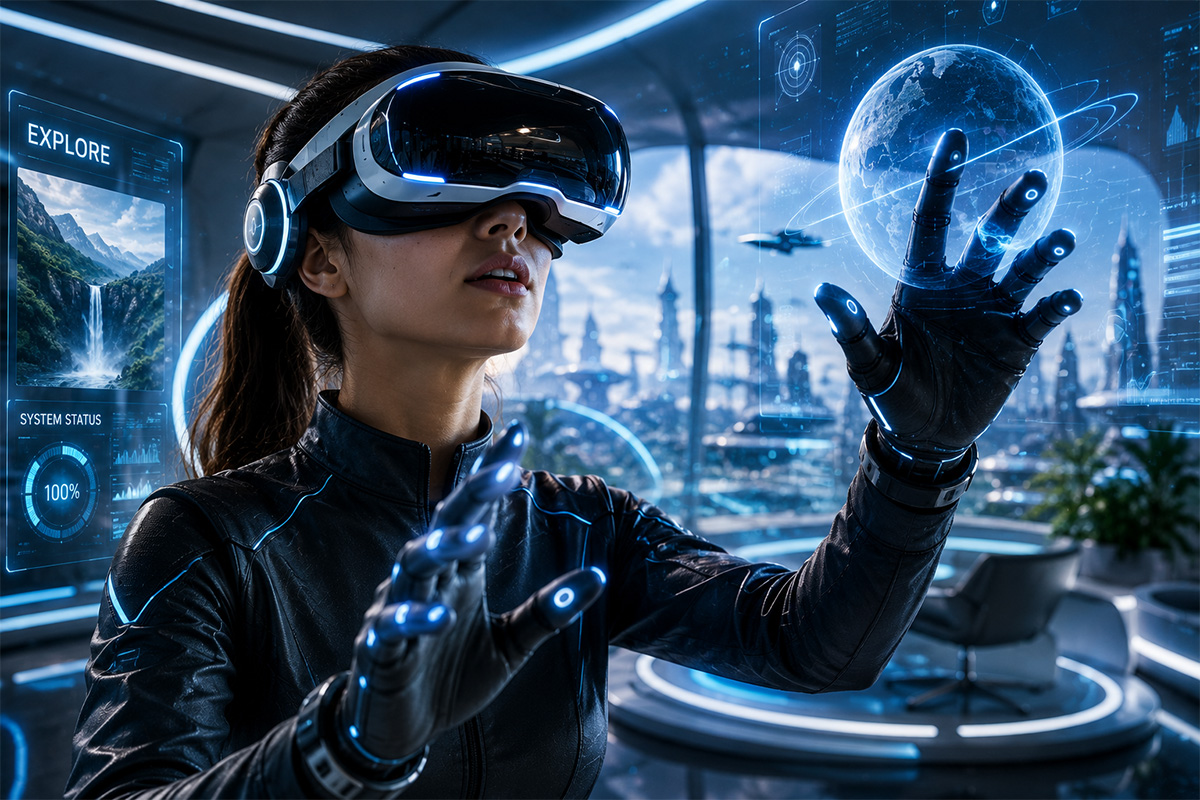
What Is Virtual Reality?
Virtual reality is a technology that creates a computer-generated three-dimensional environment that users can explore and interact with as if they were actually there. Unlike watching a movie or playing a traditional video game on a screen, VR surrounds the user with a digital world, creating a strong sense of presence—the feeling of truly being inside another place.
Virtual reality is already being used for gaming and entertainment, but it is also becoming an important tool in education, healthcare, engineering, military training, architecture, and scientific research.
How Does Virtual Reality Work?
Virtual reality combines several technologies to create an immersive experience.
The most recognizable part is the VR headset, which contains two tiny high-resolution displays—one for each eye. Each display shows a slightly different image, allowing the brain to perceive depth and creating a realistic three-dimensional scene.
Special lenses inside the headset focus the images so they appear large and natural. Most modern headsets also include built-in speakers or support headphones to provide realistic three-dimensional sound.
Motion sensors continuously measure the position and rotation of the user’s head. Every time the user looks up, down, or turns their head, the computer updates the virtual world almost instantly. This rapid response helps create the illusion that the virtual environment is fixed in place.
Tracking Movement
One of the most important parts of virtual reality is tracking. The system must know exactly where the user is looking and moving. Modern VR systems use cameras, infrared sensors, accelerometers, gyroscopes, and sometimes LiDAR (Light Detection and Ranging) sensors to measure movement with remarkable accuracy.
Many headsets also track handheld controllers that allow users to pick up objects, push buttons, paint, build, or interact naturally with the virtual environment. Some advanced systems can even track a user’s hands directly without requiring controllers.
Displays and Image Quality
The quality of a VR experience depends heavily on the displays inside the headset. Modern VR headsets often use fast LCD or OLED (Organic Light-Emitting Diode) displays with very high resolutions. Higher resolution produces sharper images and reduces the “screen door effect,” where users can notice the tiny spaces between pixels.
Refresh rate is another important factor. Many headsets operate at 90, 120, or even 144 frames per second. Faster refresh rates produce smoother motion and reduce the chances of motion sickness. Engineers continue developing brighter displays, wider fields of view, and smaller optical systems that make future headsets more comfortable and realistic.
Controllers and Haptic Feedback
Virtual reality is not only about seeing a digital world—it is also about interacting with it. Motion controllers detect the movement of a user’s hands, allowing them to grab objects, operate tools, throw balls, or manipulate virtual controls.
Some controllers include haptic feedback, which uses tiny motors to create vibrations that simulate touching or holding objects. Researchers are also developing haptic gloves and wearable suits that provide more realistic sensations by applying pressure, vibration, or resistance to different parts of the body.
These technologies make virtual experiences feel much more natural.
Artificial Intelligence in Virtual Reality
AI can create more realistic virtual characters that understand speech and respond naturally during conversations. Instead of following fixed scripts, future virtual characters may adapt to each user’s actions and communicate in much more lifelike ways.
AI also helps generate realistic environments, improve voice recognition, translate languages in real time, and automatically create digital worlds from photographs or maps. As AI continues improving, virtual worlds will become increasingly dynamic and interactive.
Virtual Reality in Education
Education is one of the most exciting applications of virtual reality. Students can explore ancient civilizations, examine the inside of a volcano, travel through the Solar System, or observe the human body from the inside without leaving the classroom.
Science students can safely perform chemistry experiments in virtual laboratories, while engineering students can assemble machines without needing expensive equipment. History lessons become more engaging when students can virtually walk through ancient cities or witness historical events recreated in three dimensions.
Virtual reality makes learning more interactive by allowing students to experience concepts rather than simply reading about them.
Healthcare and Medicine
Healthcare professionals are using virtual reality in many different ways. Medical students practice surgical procedures inside realistic simulations before operating on actual patients. Doctors use VR to plan complex surgeries by examining three-dimensional models created from CT and MRI scans.
Virtual reality also helps patients during rehabilitation by encouraging movement through interactive exercises and games. Some hospitals use VR to reduce anxiety and pain during medical procedures by distracting patients with calming virtual environments.
Researchers continue studying new medical applications that may improve treatment and recovery.
Engineering and Design
Engineers and architects increasingly use virtual reality to visualize their projects before construction begins. Instead of looking at two-dimensional drawings, designers can walk through buildings, inspect factory layouts, or explore vehicle interiors long before anything is physically built.
This allows design problems to be identified earlier, saving both time and money. Manufacturers also use VR to train workers safely on complex equipment without interrupting normal production.
Virtual Reality in Entertainment
Gaming remains one of the most popular uses of virtual reality. Players can explore fantasy worlds, solve puzzles, race vehicles, or cooperate with friends inside immersive digital environments.
Virtual concerts, museums, sporting events, and movies are also becoming more common. Instead of watching from a traditional seat, viewers may feel as though they are standing on stage with musicians or sitting courtside during a sporting event.
As graphics, sound, and interaction continue improving, entertainment experiences will become even more realistic.
Social Virtual Worlds
Virtual reality is changing how people communicate.
Instead of meeting through ordinary video calls, people can gather inside shared virtual spaces represented by digital avatars.
Friends, families, students, and coworkers can collaborate on projects, attend meetings, or participate in virtual classrooms regardless of where they live.
Future social VR platforms may become important spaces for education, business, entertainment, and international collaboration.
Challenges Facing Virtual Reality
Although virtual reality has made tremendous progress, several challenges remain.
Some users experience motion sickness if the images do not perfectly match the body’s sense of movement. Engineers continue reducing this problem through faster displays, improved tracking, and more efficient software.
Headsets can still be relatively heavy for extended use, although newer designs are becoming lighter and more comfortable.
Battery life is another limitation for standalone headsets that operate without connecting to a computer.
Cost also remains a factor, particularly for high-end systems with advanced graphics and tracking capabilities.
Privacy is becoming increasingly important because VR systems collect information about head movement, eye tracking, hand movements, and sometimes facial expressions. Protecting this data will become more important as virtual reality becomes more widespread.
The Future of Virtual Reality
The future of virtual reality is likely to be even more immersive than today’s systems.
Future headsets may become as lightweight as ordinary eyeglasses while offering much higher image quality.
Eye-tracking technology will allow computers to render only the parts of the image that users are looking at, improving performance while reducing power consumption.
Researchers are developing realistic holographic displays, advanced haptic gloves, and full-body feedback systems that may allow users to feel virtual objects much more naturally.
Artificial intelligence will generate realistic virtual people, personalized learning environments, and dynamic simulations that change automatically based on user interactions.
Cloud computing and faster wireless technologies such as 5G and future 6G networks may allow highly detailed virtual worlds to be streamed over the Internet rather than processed entirely inside the headset.
Some researchers believe virtual reality, augmented reality, and mixed reality will eventually merge into a broader field called extended reality (XR), where digital and physical environments work together seamlessly.
Virtual reality is transforming the way people learn, communicate, work, and entertain themselves. What began as a technology mainly associated with video games has become a valuable tool for education, medicine, engineering, scientific research, and business.