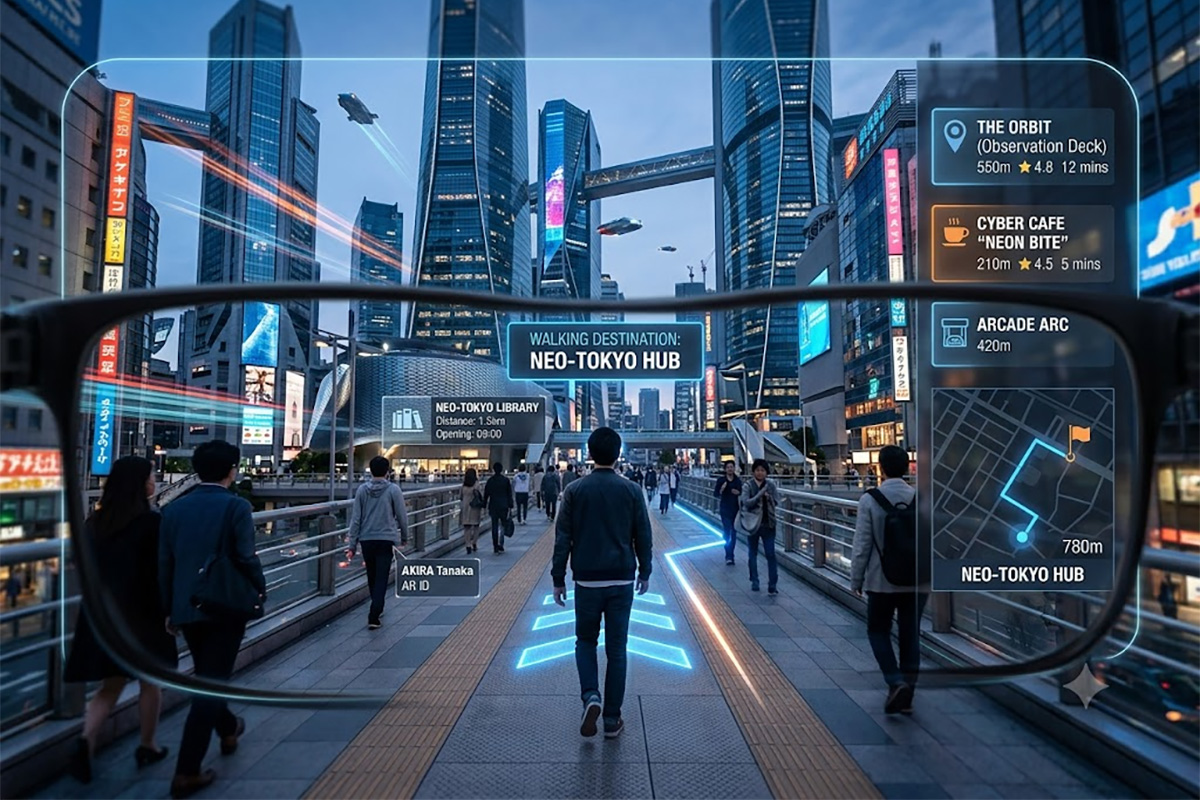
AR: Bringing Digital Information Into the Real World
What Is Augmented Reality?
If you’ve ever played a mobile game that places animated characters on your living room floor, used an app that lets you see how a new sofa would look in your home, or seen mechanic wear smart glasses that display repair instructions, you’ve already seen augmented reality, often called AR, in action. Unlike virtual reality, which replaces the real world with a completely digital environment, augmented reality adds digital information to the world you already see.
How Does Augmented Reality Work?
Augmented reality works by combining a camera, sensors, software, and a display. The camera captures the real-world scene while sensors measure the device’s position and movement. These sensors typically include accelerometers, gyroscopes, GPS receivers, and sometimes depth sensors or LiDAR (Light Detection and Ranging) scanners. The software analyzes this information and determines where digital objects should appear so they remain fixed in place as you move around. The display then combines the camera image with computer-generated graphics, creating the illusion that virtual objects exist in the real world.
AR on Smartphones and Tablets
Most people experience augmented reality through smartphones and tablets. The device’s camera shows the surrounding environment on the screen, while the software places digital objects over the live video. Because nearly everyone already owns a smartphone, mobile AR has become the most common way people use this technology. It requires no additional equipment beyond the phone itself.
Smart Glasses and AR Headsets
Another way to experience augmented reality is through smart glasses or headsets. These wearable devices project digital images directly into the user’s field of view while allowing them to continue seeing the real world. Examples include industrial smart glasses used by factory workers, medical headsets that assist surgeons during operations, and newer consumer devices designed for entertainment and productivity. Many AR glasses contain tiny projectors, transparent waveguide lenses, microphones, speakers, cameras, and powerful processors packed into a lightweight frame.
Tracking the Real World
One of the biggest technical challenges in augmented reality is something called tracking. The computer must constantly determine exactly where the user is looking and how the device is moving. Even a small tracking error can cause digital objects to drift or shake, breaking the illusion that they are attached to real-world locations. Modern AR systems use a technique called simultaneous localization and mapping (SLAM), which creates a three-dimensional map of the environment while tracking the user’s position within it.
Understanding Depth
Depth sensing is another important part of many advanced AR systems. A depth sensor measures the distance between the device and nearby objects. LiDAR scanners accomplish this by sending out pulses of infrared light and measuring how long they take to bounce back. This allows digital objects to appear behind furniture, rest naturally on tables, or interact more realistically with the surrounding environment.
Artificial Intelligence in AR
Artificial intelligence has become an important part of augmented reality. AI software can recognize objects, identify people, read text, translate signs into different languages, and understand hand gestures. For example, an AR application might recognize a plant and instantly display its species, watering requirements, and growing conditions. AI also helps improve object recognition under different lighting conditions and viewing angles.
Education and Learning
The applications for augmented reality extend far beyond games. In education, students can explore three-dimensional models of the human body, ancient buildings, or the solar system without leaving the classroom. Instead of viewing flat images in a textbook, they can walk around digital models and examine them from every angle. This interactive approach can make complex subjects easier to understand.
Healthcare Applications
Healthcare is another area where AR is making a difference. Surgeons can view medical scans overlaid on a patient’s body during certain procedures, helping them visualize internal structures more clearly. Medical students can practice procedures using realistic digital simulations before working with real patients. Physical therapists may also use AR exercises to guide patients through rehabilitation programs.
Manufacturing and Industry
Manufacturing companies use augmented reality to improve efficiency and reduce errors. Workers wearing AR glasses can receive step-by-step assembly instructions while keeping both hands free to perform their tasks. The system can highlight the correct parts, display torque specifications, and warn when a mistake is about to occur. This can shorten training time and improve product quality.
Shopping and Retail
Retail businesses have also adopted AR technology. Many furniture companies allow customers to place virtual sofas, tables, or bookshelves into their homes using a smartphone before making a purchase. Clothing retailers offer virtual fitting rooms that estimate how garments might look on a customer. Cosmetic companies provide apps that let users try different makeup colors without applying actual products.
Navigation and Travel
Navigation is another growing use for augmented reality. Instead of following a traditional map, AR navigation apps can display arrows directly on the live camera view, pointing toward the correct street or building entrance. Some airports and shopping centers are experimenting with indoor AR navigation to help visitors find gates, stores, or services more easily.
Challenges Facing AR
Although augmented reality offers many advantages, it also presents challenges. Creating accurate digital overlays requires powerful processors and efficient software, which can reduce battery life on mobile devices. Bright sunlight can make displays difficult to see, while poor lighting can make it harder for cameras to recognize the environment. Privacy is another concern because many AR devices rely on cameras that continuously observe the surrounding area. Developers must design these systems carefully to protect personal information and respect the privacy of people nearby.
Social Impact
There are also social considerations. As AR becomes more common, people may increasingly rely on digital information while interacting with the physical world. This could improve productivity and learning, but it may also raise questions about distraction, digital advertising in public spaces, and equal access to new technologies. Ensuring that AR systems are affordable, accessible, and useful for people with different abilities will be an important part of their future development.
The Future of Augmented Reality
The future of augmented reality is likely to include lighter glasses, longer battery life, more realistic graphics, and faster wireless connections through technologies such as 5G and future 6G networks. Advances in artificial intelligence will allow AR systems to better understand their surroundings and provide more helpful information in real time. Engineers are also developing smaller displays, improved eye-tracking systems, and more efficient processors that could make wearable AR devices as common as today’s smartphones.
Augmented reality is changing the way people interact with information by blending digital content with the physical world instead of replacing it. From classrooms and hospitals to factories and homes, AR is helping people learn, work, shop, and solve problems in new ways. As the technology continues to improve, it is expected to become a regular part of everyday life, making digital information available wherever and whenever it is needed.