What Is a Drone?
When most people hear the word drone, they think of a small flying camera that takes amazing aerial photographs or videos. While many drones are used for photography, they have become much more than flying cameras. Today, drones inspect bridges, monitor crops, search for missing hikers, map forests, deliver medical supplies, and even help scientists study wildlife.
A drone, also known as an uncrewed aerial vehicle (UAV) or uncrewed aircraft system (UAS), is an aircraft that flies without a pilot onboard. Instead, it is controlled remotely by a human operator or flies autonomously using computers, sensors, GPS, and artificial intelligence (AI).
As drone technology continues to improve, these aircraft are expected to become an increasingly important part of transportation, emergency response, scientific research, agriculture, and many other industries.
A Brief History of Drones
Although drones seem like a recent invention, the idea has existed for many decades. Early unmanned aircraft were developed primarily for military training and reconnaissance. As electronics became smaller, lighter, and less expensive, drones became practical for businesses, researchers, and consumers.
The introduction of compact GPS receivers, lightweight lithium-ion batteries, high-resolution digital cameras, and powerful microprocessors transformed drones from specialized aircraft into affordable flying computers. Today, millions of drones are used around the world for both recreational and professional purposes.
The Main Types of Drones
Not all drones look the same because they are designed for different jobs.
Multi-rotor drones are the most common type. They usually have four, six, or eight propellers that allow them to take off vertically, hover in one place, and maneuver with great precision. These drones are ideal for photography, inspections, surveying, and search-and-rescue operations.
Fixed-wing drones resemble small airplanes. Instead of hovering, they generate lift with their wings, allowing them to fly much farther while using less energy. Fixed-wing drones are often used for mapping large areas, monitoring pipelines, and surveying farmland.
Vertical Take-Off and Landing (VTOL) drones combine features of both designs. They can take off and land like a helicopter while flying efficiently like an airplane. VTOL drones are becoming increasingly popular because they combine flexibility with long flight times.
What Makes a Drone Fly?
A drone contains many systems working together.
The frame supports every component while keeping the aircraft lightweight and strong. Many frames are made from aluminum alloys or carbon fiber composites because these materials provide excellent strength while reducing weight.
The flight controller acts as the drone’s brain. It receives information from sensors, calculates the aircraft’s position, and continuously adjusts the motors to keep the drone stable during flight.
Electronic speed controllers regulate the amount of electrical power delivered to each motor. By changing the speed of individual motors hundreds of times each second, the drone can climb, descend, turn, or hover.
Most drones use highly efficient brushless electric motors, which produce more power, last longer, and operate more quietly than older brushed motors.
The propellers convert the motors’ rotation into lift. Small differences in blade shape, length, and pitch affect efficiency, speed, noise level, and lifting capacity.
Power usually comes from rechargeable lithium-ion or lithium-polymer batteries. Battery technology continues to improve, allowing drones to remain airborne longer while carrying heavier equipment. Researchers are also developing hydrogen fuel cells and solar-powered drones that may someday remain in the air for days or even months.
Cameras and Advanced Sensors
Many drones carry much more than ordinary cameras.
High-resolution cameras allow engineers to inspect bridges, power lines, wind turbines, and buildings without climbing dangerous structures. Using a technique called photogrammetry, software combines hundreds of overlapping photographs into detailed three-dimensional maps and models.
Some drones carry thermal infrared cameras that detect heat. Firefighters use thermal drones to locate hidden hot spots after a wildfire, while search-and-rescue teams can find missing people by detecting body heat.
LiDAR (Light Detection and Ranging) systems use laser pulses to measure distances with remarkable accuracy. LiDAR-equipped drones can create highly detailed three-dimensional maps of forests, construction sites, roads, and archaeological ruins, even in areas where dense vegetation hides the ground.
Scientists also equip drones with sensors that measure air quality, radiation, humidity, atmospheric gases, and chemical pollutants. These flying laboratories can safely collect information from hazardous environments that would be dangerous for people.
Artificial Intelligence Makes Drones Smarter
One of the biggest advances in drone technology is artificial intelligence.
Early drones depended almost entirely on human pilots. Today’s drones can automatically avoid obstacles, follow moving objects, return safely when batteries become low, and fly along pre-programmed routes.
Computer vision allows drones to recognize roads, buildings, trees, vehicles, and people using onboard cameras. AI systems can also analyze images during flight, reducing the amount of information that must be sent back to the operator.
Future drones will become even more autonomous. They may inspect infrastructure, monitor crops, or deliver supplies with very little human supervision while still allowing operators to take control whenever necessary.
Drone Swarms
One exciting area of research is drone swarms.
Instead of operating one drone at a time, dozens or even hundreds of drones can work together as a coordinated team. Each drone communicates with nearby drones while sharing information about its surroundings.
Swarms could rapidly search large disaster areas, inspect long power lines, monitor wildfires, or plant thousands of trees after forest fires. If one drone develops a problem, the remaining drones can often continue the mission.
Scientists are still developing safe methods for coordinating large numbers of autonomous aircraft, but swarm technology has enormous potential.
Drones in Everyday Life
Drones are already becoming valuable tools in many industries.
Farmers use drones to monitor crop health, measure soil conditions, detect irrigation problems, and apply fertilizers only where they are needed. This precision agriculture helps reduce costs while conserving water and minimizing environmental impacts.
Construction companies use drones to monitor job sites, measure earthmoving progress, inspect tall structures, and compare completed work with digital building plans.
Utility companies inspect electrical transmission lines, solar farms, pipelines, and communication towers without placing workers in dangerous situations.
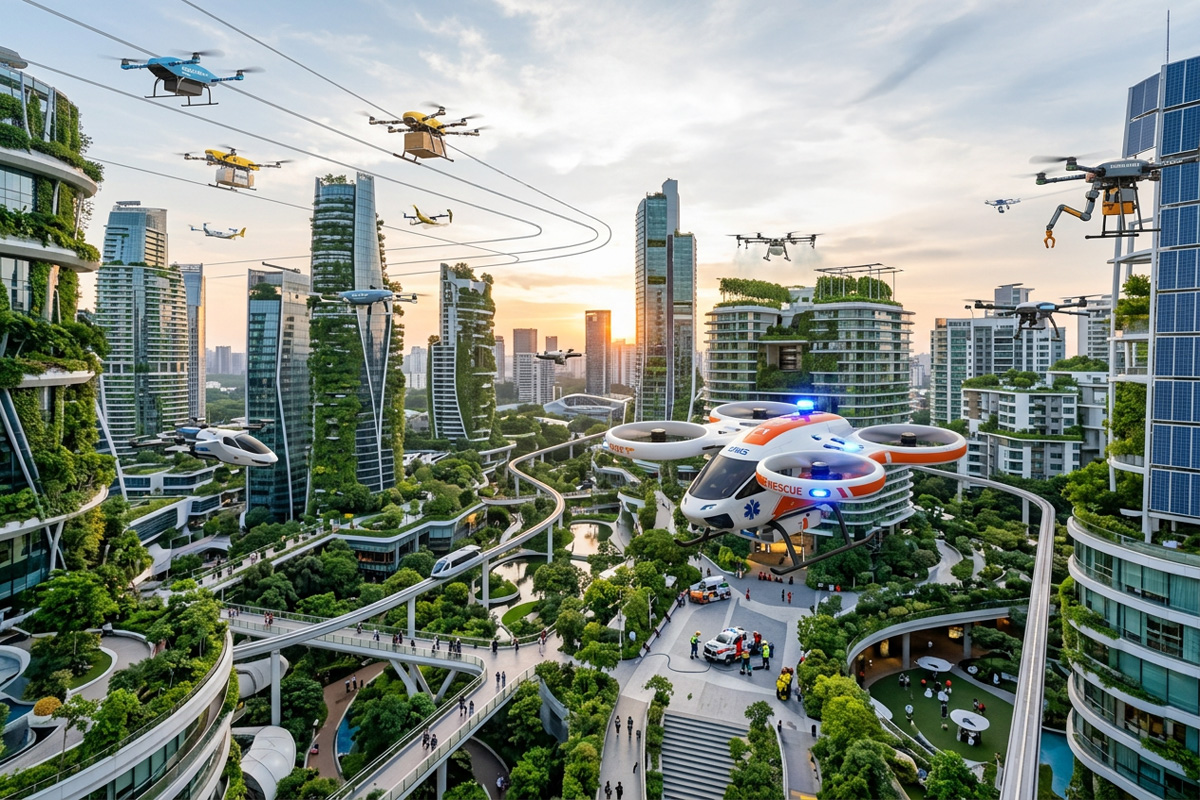
Emergency responders use drones to assess storm damage, locate survivors after natural disasters, deliver emergency medical equipment, and monitor wildfires from safe distances.
Scientists use drones to study wildlife, monitor glaciers, measure volcanic activity, and observe ecosystems with minimal disturbance to animals.
Drone Delivery
One of the most widely discussed future applications is drone delivery.
Companies are testing drones capable of transporting small packages, medical supplies, laboratory samples, and emergency equipment directly to homes or hospitals. In remote communities where roads are limited, drones can deliver life-saving medicines much faster than traditional vehicles.
Although regular drone deliveries are expanding in some locations, engineers must still solve challenges involving weather, battery life, air traffic management, and safety before large-scale delivery networks become common.
Challenges Facing Drone Technology
Despite their many advantages, drones still face important limitations.
Battery life remains one of the biggest challenges. Most small consumer drones can only fly for about 20 to 45 minutes before recharging. Engineers continue searching for lighter batteries with greater energy storage.
Weather also limits drone operations. Strong winds, heavy rain, snow, and ice can reduce stability and increase safety risks.
Airspace management is another challenge. As more drones share the skies with airplanes and helicopters, new systems will be needed to safely coordinate thousands of aircraft operating at low altitudes.
Privacy is another important issue. Because drones often carry cameras and sensors, governments and manufacturers must develop rules that protect personal privacy while allowing drones to perform useful tasks.
Cybersecurity is becoming increasingly important as well. Protecting drones from hacking and unauthorized control will be essential as they become part of transportation, infrastructure, and emergency response systems.
Careers in Drone Technology
Drone technology combines many areas of science, engineering, and computer science.
Engineers design lightweight aircraft structures, motors, batteries, and electronics. Software developers create navigation systems and artificial intelligence algorithms. Robotics specialists improve autonomous flight, while data scientists analyze the information collected by drone sensors.
Drone pilots, surveyors, environmental scientists, photographers, agricultural specialists, emergency responders, and infrastructure inspectors all use drones as part of their work.
As drone technology continues advancing, new careers will continue to emerge in industries that are only beginning to explore what these aircraft can accomplish.
The Future of Drones
The next generation of drones will likely fly farther, carry heavier equipment, operate more quietly, and make more decisions on their own using artificial intelligence.
Future drones may communicate directly with one another, charging stations, smart cities, and other autonomous vehicles. Improvements in battery technology, hydrogen fuel cells, lightweight materials, and wireless communication could allow drones to remain airborne much longer while completing increasingly complex missions.
Researchers are also developing drones capable of changing shape during flight, folding their wings for transportation, or working alongside ground robots and autonomous boats as part of coordinated robotic teams.
Rather than replacing people, drones will increasingly serve as intelligent tools that help humans perform difficult, dangerous, or repetitive tasks more safely and efficiently.
Evolving Drones
Drones have evolved from simple remote-controlled aircraft into sophisticated flying robots that combine advanced electronics, sensors, artificial intelligence, and communication systems. They are already improving photography, agriculture, construction, environmental science, emergency response, and infrastructure inspection.
In the future, drones will likely become even more capable as advances in AI, batteries, sensors, and autonomous navigation continue. They will help deliver supplies, monitor the environment, support scientific research, assist first responders, and perform many jobs that are difficult or unsafe for humans.
For today’s high-school students, drones represent far more than an exciting technology. They are an example of how engineering, computer science, robotics, and artificial intelligence are coming together to solve real-world problems. Understanding how drones work today provides a glimpse into a future where intelligent flying machines become an everyday part of life.