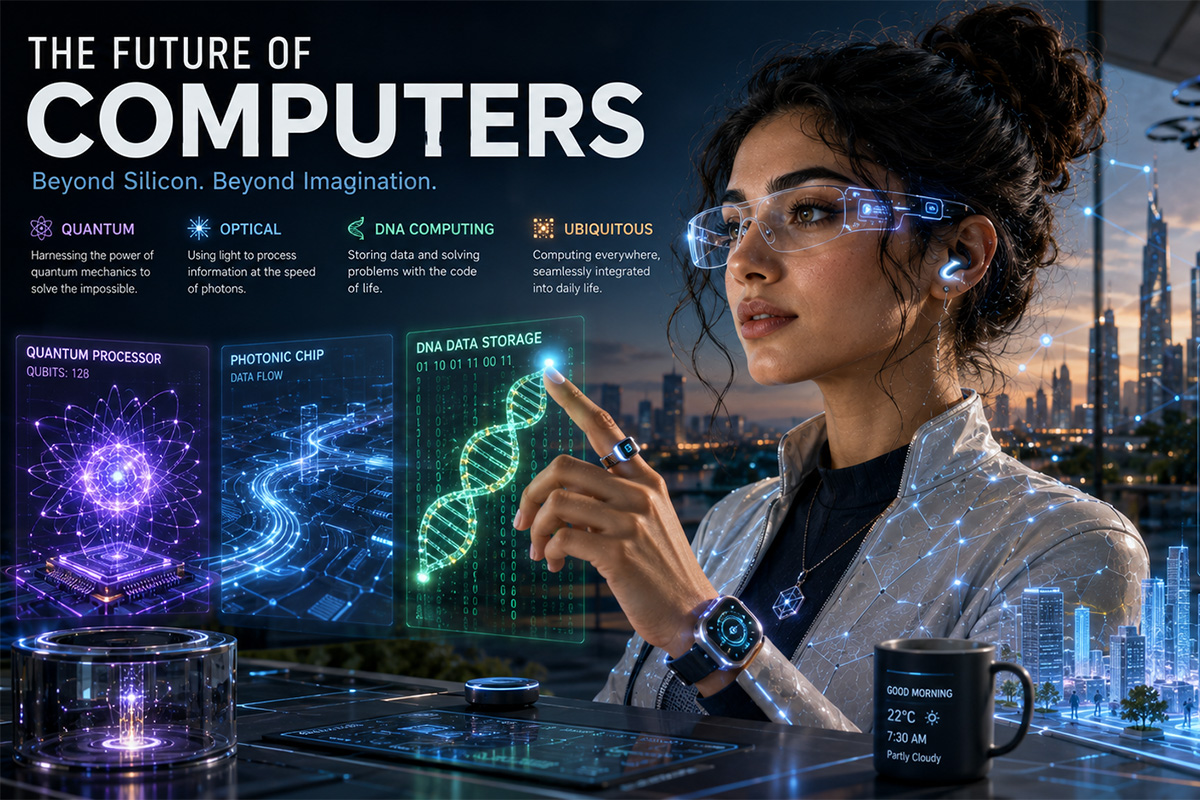
The Future of Computers: Beyond Silicon Chips
Computers have changed enormously in just a few generations. Early electronic computers filled entire rooms, consumed large amounts of electricity, and had far less computing power than a modern smartphone. Today, powerful computers fit into watches, cars, cameras, appliances, and even medical devices.
For decades, much of this progress came from making the transistors inside computer chips smaller and packing more of them onto a piece of silicon. Smaller transistors helped computers become faster, cheaper, and more energy-efficient.
But shrinking conventional electronics cannot continue forever. At extremely small scales, heat, power consumption, manufacturing difficulty, and the strange behavior of electrons create serious challenges.
This does not mean computer progress is ending. Instead, scientists and engineers are investigating completely different ways of computing.
Quantum computers use quantum physics. Optical computers use light. DNA computers use biological molecules. Neuromorphic computers attempt to borrow ideas from the brain. And ubiquitous computing could make computers so common that we barely notice them.
The computer of the future may not be one machine sitting on a desk. Computing could surround us—and different types of computers may work together depending on the problem that needs to be solved.
The Silicon Computer
Almost every computer we use today depends on silicon semiconductor technology.
At the heart of a processor are microscopic electronic switches called transistors. A modern processor can contain billions of them. Transistors switch electrical signals on and off, allowing computers to represent and manipulate binary digits, or bits. A conventional bit has one of two values: 0 or 1.
By combining enormous numbers of these simple operations, computers can perform everything from displaying a webpage to generating an AI response. Engineers have spent decades making transistors smaller. However, today’s most advanced chips contain features only a few nanometers across.
At these scales, continuing to improve computers becomes increasingly complicated and expensive. Future computing will therefore involve more than simply making today’s processors smaller.
Specialized Computers
One important change is already happening: computers are becoming more specialized.
A traditional central processing unit (CPU) is designed to perform many different types of calculations. But certain problems can be handled more efficiently by processors designed for particular tasks.
Graphics processing units (GPUs) were originally developed primarily to process computer graphics, but their ability to perform many calculations in parallel has made them extremely important for artificial intelligence and scientific computing.
Other specialized processors are being developed specifically for machine learning, communications, image processing, and other applications.
Future computers may contain several different types of processors, with software automatically selecting the best hardware for each job.
Quantum Computing
One of the most unusual approaches to future computing is the quantum computer. A conventional computer processes bits that represent either 0 or 1. A quantum computer uses quantum bits, usually called qubits.
Qubits take advantage of properties of quantum mechanics such as superposition and entanglement. Superposition allows a qubit to be described by a combination of the 0 and 1 states until it is measured. Entanglement creates correlations between qubits that have no direct equivalent in ordinary computing.
This does not simply mean that a quantum computer tries every possible answer simultaneously. Quantum algorithms carefully manipulate probability amplitudes so that useful answers become more likely when the system is measured.
That makes quantum computing very different from simply building a faster conventional computer.
What Could Quantum Computers Do?
Quantum computers are not expected to replace your laptop or smartphone. Instead, they could eventually become extremely powerful tools for certain specialized problems.
Chemistry is one promising application because molecules themselves obey quantum mechanics. Large, fault-tolerant quantum computers could potentially simulate some molecules and materials more effectively than conventional computers. This could help researchers investigate new medicines, catalysts, batteries, superconductors, and industrial chemicals.
Quantum algorithms could also affect certain optimization and mathematical problems. One particularly important application is cryptography. A sufficiently capable fault-tolerant quantum computer could threaten some widely used public-key encryption methods. This is why researchers are already developing and deploying post-quantum cryptography designed to remain secure against known quantum attacks.
Why Don’t We Already Have Powerful Quantum Computers?
Qubits are extremely difficult to control.
Quantum states are fragile. Heat, vibration, electromagnetic interference, and interactions with the surrounding environment can introduce errors through a process related to decoherence. Researchers are experimenting with several approaches to building qubits, including superconducting circuits, trapped ions, neutral atoms, photons, and semiconductor-based systems.
Another major challenge is quantum error correction. A useful fault-tolerant quantum computer may need many physical qubits working together to create more reliable logical qubits. Exactly how many are required depends on the hardware, error rates, and computation.
Quantum computing is therefore a real and rapidly developing technology, but today’s machines remain far from the universal, error-corrected quantum computers imagined for many future applications.
Optical Computing: Using Light Instead of Electricity
Another approach replaces some electrical signals with light. This is known as optical or photonic computing. Traditional processors move electrical signals through microscopic circuits. Photonic systems manipulate particles of light called photons.
Light has some useful properties for computing. Multiple optical signals can travel through the same region using different wavelengths, and certain mathematical operations can be performed efficiently using optical components.
Photonic technology is already essential for communications. Fiber-optic cables transmit enormous amounts of information using pulses of light. Future computers could bring more of that technology directly onto computer chips.
Photonic Chips
A photonic integrated circuit is somewhat like an electronic integrated circuit, except it contains structures that guide and manipulate light. Tiny waveguides act somewhat like microscopic optical pathways. Other components can split, combine, filter, modulate, or detect light. One major opportunity is moving information.
As processors become more powerful, transferring data between processors and memory consumes significant energy. Optical connections could potentially move large quantities of information with high bandwidth and improved energy efficiency in some applications.
Future data centers may therefore use increasingly sophisticated optical links both between computers and eventually between components inside computing systems.
DNA Computing
Perhaps the strangest future computer is one made from the same type of molecule that carries genetic information in living organisms.
DNA contains information using four chemical bases: adenine (A), thymine (T), cytosine (C), and guanine (G).
Instead of storing information as electrical 0s and 1s, researchers can encode digital information into sequences of these DNA bases. DNA molecules can also interact through predictable chemical rules. Scientists can use these interactions to perform certain calculations.
This field is known as DNA computing or, more broadly, molecular computing.
A test tube does not look much like a computer, but if molecules are storing information and following designed operations, they can be used as a form of computation.
Massive Parallelism
One interesting feature of DNA computing is parallelism. A conventional processor performs operations using electronic circuits. In a DNA computing experiment, enormous numbers of molecules can participate in reactions simultaneously.
This could make molecular computing useful for certain problems where many possible combinations need to be explored. However, DNA computing has major disadvantages. Preparing molecules, controlling chemical reactions, correcting errors, and reading results can be slow and complicated.
You probably will not be playing video games on a DNA laptop. Instead, molecular computers could become specialized tools for biology, medicine, data storage, and scientific research.
DNA as Data Storage
DNA may have an even more interesting future as a storage technology. Nature has already demonstrated that DNA can preserve enormous amounts of biological information in a microscopic space.
Researchers can convert digital files into sequences made from A, T, C, and G. Those sequences can then be chemically synthesized as DNA. Later, DNA sequencing can read the molecules, and software can reconstruct the original data.
DNA storage could theoretically provide extremely high information density and long-term stability under appropriate conditions.
The biggest problems today include cost and speed. Writing synthetic DNA is far slower and more expensive than saving information to a conventional drive.
For information that needs to be archived for decades or centuries rather than accessed every few seconds, however, future DNA storage could become much more interesting.
Computers Inside Living Cells
DNA and molecular computing create an even more futuristic possibility: computers that operate inside biological systems. Synthetic biologists can design genetic circuits that respond to chemical conditions inside cells.
A future molecular system might detect several biological signals and produce an output only when a particular combination is present.
One possible long-term medical application would be a biological system that recognizes molecular signs associated with a disease and then triggers a carefully designed response. This is very different from shrinking a silicon computer and putting it inside a cell. The biological molecules themselves perform the sensing and logic.
Computing could therefore eventually become part of medicine at the cellular level.
Neuromorphic Computing
Another possible future computer takes inspiration from one of the most remarkable information-processing systems we know: the human brain. This approach is called neuromorphic computing. Traditional computers usually keep processing and memory largely separate. Information constantly moves between processors and memory, which requires time and energy.
The brain operates differently. Neurons and their connections participate in both storing and processing information throughout a highly interconnected network. Neuromorphic chips attempt to reproduce some of these principles electronically.
Many use artificial neurons that communicate through short electrical events called spikes. This can make certain systems highly efficient, particularly when relatively little activity is occurring. Neuromorphic computing could eventually become useful for robots, autonomous machines, sensors, and AI systems that need to operate continuously while consuming little power.
Computing at the Edge
Today, much of our computing happens far away from us. When you use an online AI service or cloud application, information may travel to a data center containing thousands of computers. Future systems will increasingly combine this cloud computing with edge computing.
Edge computing means processing information closer to where it is produced. For example, an autonomous car cannot always wait for a distant data center to decide whether it should brake for a pedestrian. Critical calculations need to happen inside the vehicle. A medical wearable may process sensitive health information locally rather than continuously uploading raw data.
Future computers will therefore be distributed between powerful data centers and billions of smaller devices operating at the edge of the network.
Ubiquitous Computing
This leads to one of the biggest ideas about the future of computers: ubiquitous computing. Ubiquitous means something that seems to be everywhere.
Today, we still tend to think of a computer as an object—a laptop, smartphone, tablet, or desktop. In a world of ubiquitous computing, the computer begins to disappear as a separate object.
Computing could be built into clothing, eyeglasses, vehicles, buildings, furniture, roads, medical devices, appliances, factories, and cities. Instead of going to a computer to use technology, computing would be available throughout the environment whenever it is needed.
A Ubiquitous Home
Imagine walking into a future home. The house recognizes that someone has entered without requiring them to open an app. Lighting and temperature adjust automatically. A kitchen monitors energy use and can help prevent food waste. Windows automatically change how much sunlight they allow through, while sensors detect water leaks before significant damage occurs.
Wearable medical devices communicate with home systems when appropriate, while an AI assistant can be accessed from different rooms without being tied to one screen. The technology could be extremely sophisticated, but the experience might actually feel less technological because people would spend less time operating individual devices.
The best ubiquitous computer may be one you rarely have to think about.
Computers in Future Cities
Ubiquitous computing could extend across entire cities. Traffic signals could communicate with vehicles. Bridges might contain sensors that monitor structural conditions. Water systems could detect leaks, and environmental sensors could continuously measure air quality.
Autonomous buses could adjust routes according to passenger demand. Buildings might automatically manage energy consumption based on weather, occupancy, and electricity availability. These technologies are part of the idea behind the smart city.
Rather than waiting for something to fail, computer systems could recognize patterns suggesting that maintenance will soon be required. Cities could become more efficient, but they could also become enormous data-collection systems. That makes privacy and cybersecurity essential parts of ubiquitous computing.
Wearable and Invisible Computers
Wearables are another step toward ubiquitous computing. Smartwatches and rings are already small computers that remain with us throughout the day. Future computers could become integrated directly into clothing, glasses, earbuds, medical patches, and jewelry. Augmented reality glasses might provide a digital display without requiring users to look at a phone.
Smart clothing could monitor health and environmental conditions, while AI assistants provide information through almost invisible interfaces. Eventually, the smartphone may no longer need to be the center of personal computing. Its functions could be distributed among several devices around the body and environment.
Spatial Computing
Computers may also become less dependent on rectangular screens. Spatial computing combines technologies such as augmented reality, virtual reality, computer vision, sensors, and 3D interfaces so that digital information can interact with physical space.
Instead of viewing a three-dimensional model on a flat monitor, an engineering student might walk around a life-sized virtual engine. A medical student could examine a digital human heart from different angles. Architects could stand inside virtual versions of buildings before construction begins.
If lightweight AR glasses eventually become practical enough for everyday use, physical spaces could effectively become part of the computer interface.
AI Changes How We Use Computers
The future of computing is not only about hardware. Artificial intelligence is changing the interface between humans and machines. For decades, people had to learn how computers wanted to receive instructions. We learned programming languages, menus, commands, icons, and search terms. Generative AI is beginning to reverse this relationship.
People can increasingly describe what they want using ordinary language, while the computer determines some of the steps required to accomplish it. Future AI systems could allow users to create software, analyze data, design objects, control robots, and manage complex computer systems through conversation and other natural interfaces.
This could make advanced computing available to people who have never learned traditional programming.
The Future Data Center
Although personal computers may become less visible, the computers behind digital services could become enormous. AI, scientific simulations, weather forecasting, medical research, and other applications require huge amounts of computation.
Future data centers will need faster processors, advanced cooling, high-speed optical connections, and enormous quantities of electricity. Energy efficiency will therefore become one of the most important challenges in computing. A processor that is twice as fast but consumes four times as much energy may not be a good solution when millions of processors are operating together.
Future computing research will increasingly measure progress not just by speed, but by how much useful computation can be performed for a given amount of energy.
Computers and Climate Science
More powerful computers could help society understand and respond to climate change. Climate models divide the atmosphere, oceans, land, and ice into mathematical regions and simulate how these systems interact. Greater computing power can allow researchers to run more detailed models and explore larger numbers of possible scenarios.
AI could help analyze satellite observations, predict electricity demand, improve renewable energy systems, and optimize transportation networks. Specialized computers may also help scientists discover improved battery materials, catalysts, and other technologies important for clean energy.
Future computing will consume energy, but it can also become an important tool for reducing energy use elsewhere.
Quantum, Optical, and Classical Computers Working Together
There probably will not be one type of computer that replaces everything else. Instead, future computing may become heterogeneous, meaning different technologies work together. A conventional CPU could manage an application. A GPU might handle AI calculations. A photonic accelerator could perform specialized matrix operations.
A quantum processor located in a specialized facility might handle a particular scientific calculation, while a supercomputer performs the rest. DNA might store enormous archival datasets, while tiny edge processors analyze sensor information close to where it is collected.
The computer of the future could therefore be less like one machine and more like an ecosystem of different computing technologies.
Privacy in a World Full of Computers
Ubiquitous computing creates an obvious social problem. If computers are everywhere, sensors could be everywhere too. Smart glasses might contain cameras. Cars could record their surroundings. Homes may contain microphones and motion detectors, while wearable devices continuously collect biological information.
The same information that makes these technologies useful can also reveal details about people’s lives. Future computer systems will need privacy protections built into their design.
One approach is to process information locally whenever possible. A smart camera might determine that a person has entered a room without identifying that person or uploading the video. Encryption can protect information during storage and communication, while privacy rules can limit how data is collected and shared.
In a world of ubiquitous computing, privacy cannot simply be an optional setting buried inside a menu. It will need to become part of the architecture of the system.
Cybersecurity in the Future
Security becomes equally important when computers control physical objects. A compromised social media account is a problem. A compromised computer controlling a vehicle, medical device, power system, or building could create physical danger. Future cybersecurity will therefore protect much more than files and passwords.
Researchers are also preparing for the possibility that future quantum computers could break some existing cryptographic systems. Post-quantum cryptography is being developed so that sensitive information can remain protected even in a future containing powerful quantum computers.
As computing becomes part of critical infrastructure, cybersecurity will increasingly become a form of public safety.
The Digital Divide
More powerful computers do not automatically create a fairer society. Access matters. A person with fast Internet, modern computing hardware, and sophisticated AI tools may have opportunities unavailable to someone without reliable connectivity.
As computers become more important in education, healthcare, employment, and government services, lack of access can become a serious disadvantage. Ubiquitous computing could make technology cheaper and more widely available, but it could also create new inequalities if advanced systems are concentrated in wealthier communities.
The future of computing should therefore involve not only creating more powerful machines, but making useful computing and connectivity accessible to more people.
How Future Computers Could Change Jobs
Computers have been changing work since long before the personal computer. AI and automation could accelerate that process. Computers may increasingly handle routine data processing, programming, translation, scheduling, manufacturing, and administrative tasks.
At the same time, new careers will emerge around quantum computing, photonics, AI, robotics, cybersecurity, semiconductor engineering, biotechnology, data centers, and technologies that have not yet been invented. Many existing professions will change rather than disappear.
Doctors may work with medical AI. Engineers could collaborate with generative design systems. Scientists may use quantum and AI tools, while teachers use intelligent educational software.
Learning how to work with computers may become more important than competing against them.
We may stop thinking about “using a computer” in the same way that we rarely think about using an electric motor when a refrigerator starts cooling or an elevator begins moving. Computing could simply become part of how objects and environments work.