What Is the Internet of Things?
Imagine waking up in the morning and your alarm clock tells the coffee maker to start brewing your favorite drink. Your thermostat adjusts the temperature before you get out of bed, your smartwatch tracks your sleep, and your car reminds you that one of its tires needs air before you leave for school or work. These are examples of the Internet of Things, often called the IoT.
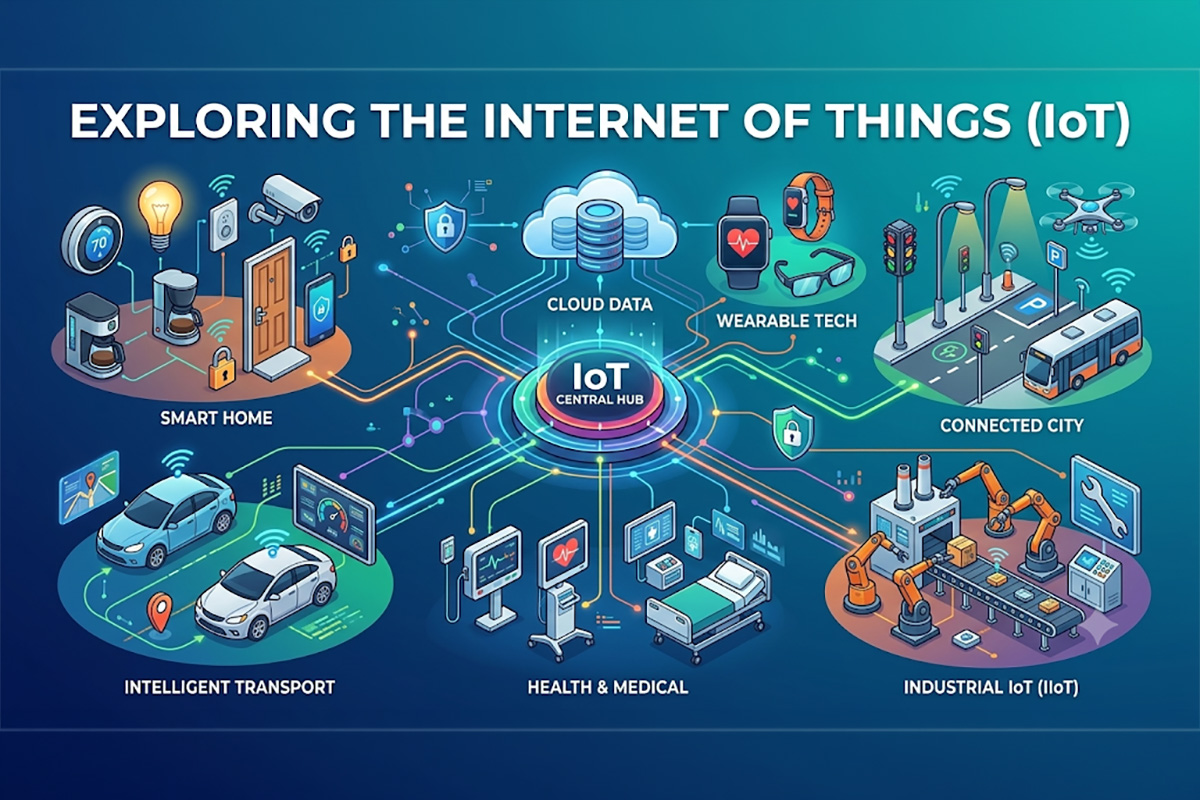
The Internet of Things is a network of physical objects that are connected to the Internet. These objects collect information using sensors, communicate with other devices, and often make decisions automatically. Instead of computers and smartphones being the only devices connected to the Internet, everyday objects—from refrigerators to traffic lights—can now share information.
Today, billions of IoT devices are already operating around the world, and that number continues to grow every year.
How Does the Internet of Things Work?
An IoT system is made up of several key parts that work together.
First, there are the devices themselves. These can include smart watches, security cameras, appliances, vehicles, factory machines, medical equipment, and even farm equipment.
Next are sensors. Sensors collect information about the world around them. They can measure temperature, humidity, pressure, light, motion, sound, air quality, location, or many other conditions.
The devices then send this information through communication networks such as Wi-Fi, Bluetooth, cellular networks, satellite communications, or specialized low-power wireless systems.
Once the information reaches a computer or cloud server, software analyzes the data and determines what action should be taken. Sometimes the system simply sends information to a person. Other times, it automatically performs a task, such as turning on lights, adjusting a thermostat, or alerting emergency responders.
Artificial intelligence is increasingly being used to analyze the enormous amounts of data generated by IoT devices, making these systems smarter over time.
Sensors: The Eyes and Ears of the IoT
Sensors are one of the most important parts of the Internet of Things. A temperature sensor can monitor the inside of a refrigerator. Motion sensors detect when someone enters a room. GPS receivers track the location of vehicles. Cameras provide images that artificial intelligence can analyze. Microphones detect sounds, while air quality sensors measure pollution levels.
Modern sensors are becoming smaller, more accurate, and less expensive. Some are so tiny that they can fit inside wearable devices, medical implants, or industrial equipment. As sensor technology continues to improve, IoT devices will gain a better understanding of the world around them.
Smart Homes
One of the most familiar uses of the Internet of Things is the smart home. Smart thermostats automatically adjust heating and cooling based on occupancy and weather conditions. Smart lighting systems can turn lights on or off when someone enters a room. Smart doorbells allow homeowners to see visitors using a smartphone, even when they are away.
Connected appliances can monitor energy use, remind owners when maintenance is needed, or automatically reorder supplies when they begin running low. These systems make homes more convenient while helping reduce energy consumption and operating costs.
Smart Cities
Entire cities are beginning to use IoT technology. Traffic sensors monitor vehicle flow and adjust traffic lights to reduce congestion. Smart parking systems guide drivers directly to available parking spaces, saving time and fuel.
Sensors can monitor bridges, roads, and water systems to detect problems before they become dangerous. Streetlights may automatically brighten when pedestrians approach and dim when streets are empty, conserving electricity. Some cities also use connected environmental sensors to measure air quality, noise levels, weather conditions, and water quality, providing valuable information for city planners and emergency services.
Healthcare and Wearable Technology
Healthcare is one of the fastest-growing areas for IoT technology. Smart watches and fitness trackers monitor heart rate, physical activity, blood oxygen levels, and sleep patterns. Some wearable devices can even detect irregular heart rhythms and notify both the wearer and healthcare providers.
Patients with chronic medical conditions may use connected medical devices that automatically send health information to doctors, allowing problems to be identified earlier. Hospitals are also using IoT systems to track medical equipment, monitor patients, manage medication, and improve overall efficiency.
As wearable technology continues to improve, healthcare may become more personalized and preventive rather than simply treating illnesses after they occur.
Agriculture and Food Production
Farmers are using IoT technology to grow more food while using fewer resources. Soil moisture sensors determine exactly when crops need watering. Weather stations provide detailed local forecasts. Connected irrigation systems automatically deliver water only where it is needed.
Drones equipped with cameras and sensors monitor crop health, identify plant diseases, and detect insect infestations before they spread. Livestock can wear tracking devices that monitor their health and location, helping farmers identify sick animals more quickly.
These technologies increase food production while reducing water use, fertilizer use, and environmental impacts.
Manufacturing and Industry
Factories are becoming smarter through the Industrial Internet of Things, often called IIoT. Machines continuously monitor their own performance using vibration, temperature, and pressure sensors. Artificial intelligence analyzes this information to predict equipment failures before they happen.
This approach, known as predictive maintenance, allows companies to repair equipment before a costly breakdown occurs. Connected robots, conveyor systems, and quality-control cameras communicate with one another to improve manufacturing efficiency while reducing waste.
Transportation and Autonomous Vehicles
Modern vehicles already contain hundreds of sensors and dozens of computers. Future vehicles will communicate with one another, traffic signals, roads, and navigation systems. This exchange of information can improve safety by warning drivers about accidents, road hazards, or dangerous weather ahead.
Autonomous vehicles rely heavily on IoT technology, combining cameras, radar, LiDAR, GPS, and communication networks to understand their surroundings. Delivery drones, autonomous trucks, and connected public transportation systems will also depend on IoT networks.
Artificial Intelligence Makes IoT Smarter
The Internet of Things generates enormous amounts of information every second. Artificial intelligence helps analyze this data much faster than humans could. AI can recognize patterns, predict equipment failures, optimize energy use, identify security threats, and recommend actions.
Instead of simply collecting information, future IoT systems will increasingly make intelligent decisions on their own while keeping humans informed. The combination of AI and IoT is sometimes called the Artificial Intelligence of Things (AIoT), and it is expected to become one of the fastest-growing areas of technology.
Challenges and Security
While the Internet of Things offers many benefits, it also creates new challenges. Every connected device represents a potential entry point for hackers if it is not properly secured. Manufacturers must design strong cybersecurity protections into their products from the beginning.
Privacy is another important concern. Many IoT devices collect personal information, including location, health data, or daily routines. Companies must protect this information and give users control over how their data is used.
Another challenge is compatibility. Devices made by different companies do not always communicate easily with one another. Industry standards are improving, but better interoperability will be needed as IoT continues to expand.
The Future of the Internet of Things
The next generation of IoT devices will become much more intelligent.
Artificial intelligence will allow devices to make better decisions with less human involvement. Faster communication technologies such as 5G and future 6G networks will allow billions of devices to exchange information almost instantly.
Tiny sensors powered by harvested energy from sunlight, heat, vibration, or radio waves may operate for years without replacing batteries.
Digital twins—virtual computer models of buildings, factories, power plants, and even entire cities—will use IoT data to simulate real-world conditions and predict future problems before they occur.
Future homes may automatically conserve energy based on weather forecasts. Smart hospitals could continuously monitor patients using connected sensors. Entire transportation systems may coordinate traffic automatically to reduce accidents and save fuel.
Eventually, trillions of connected devices could work together to create an intelligent digital infrastructure that quietly improves daily life.
Careers in the Internet of Things
The Internet of Things combines many different areas of science and engineering.
Computer programmers develop software that allows devices to communicate. Electrical engineers design sensors and electronics. Network engineers build communication systems. Cybersecurity specialists protect connected devices from attacks. Data scientists analyze the information collected by IoT systems, while artificial intelligence engineers create software that helps devices make intelligent decisions.
As connected technology expands, demand for workers with these skills is expected to continue growing.
Connecting the Dots
The Internet of Things is changing how people interact with technology by allowing everyday objects to communicate, collect information, and make intelligent decisions. From smart homes and hospitals to farms, factories, and cities, IoT is improving efficiency, reducing waste, increasing safety, and helping people solve complex problems.
As artificial intelligence, wireless communication, sensors, and robotics continue advancing, the Internet of Things will become even more powerful. Future generations may live in a world where billions—or even trillions—of connected devices work together almost invisibly to improve transportation, healthcare, education, energy, and environmental protection.