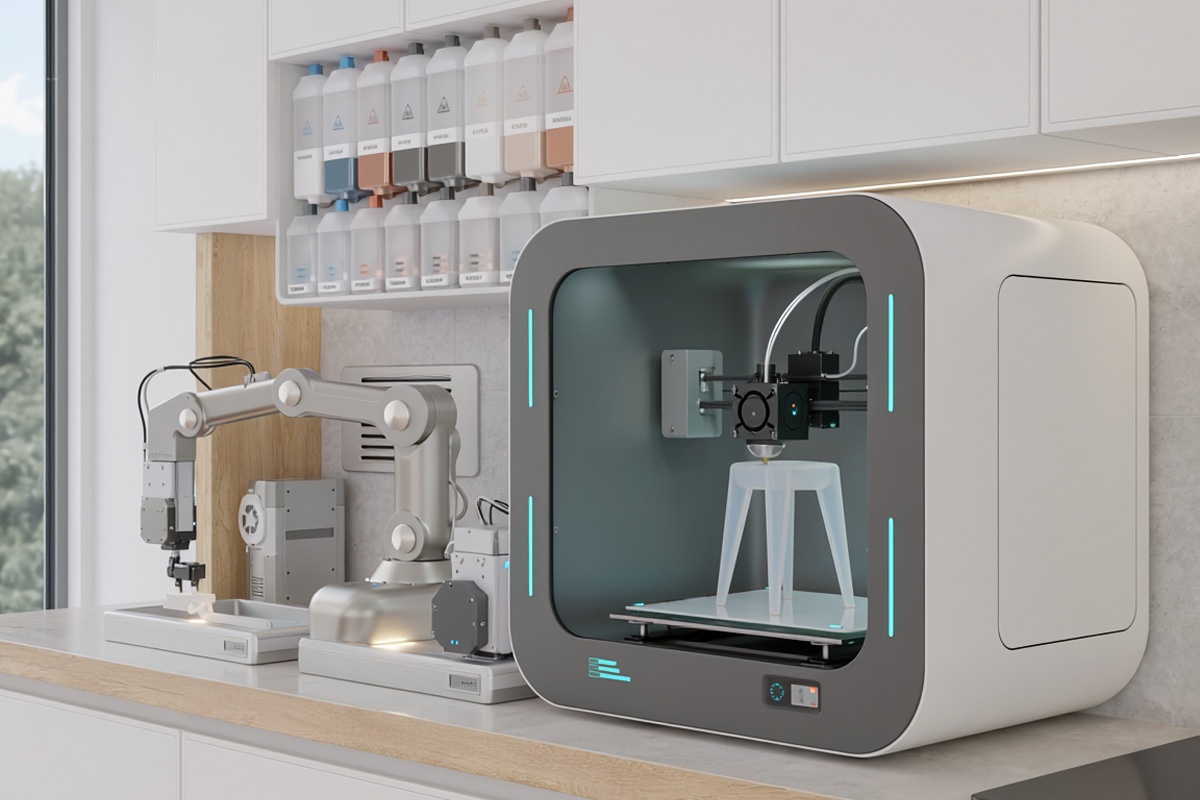
Broke Your Coffee Mug? Why Not Print a New One?
Imagine dropping your favorite coffee mug, watching it shatter, and then simply printing a replacement at home. That might sound like science fiction, but 3D printing is making ideas like this increasingly realistic.
In my opinion, 3D printing is one of the fastest-growing areas of modern technology. It has grown far beyond making simple prototypes for engineers. Today, 3D printers are used to create everything from toys and replacement parts to medical devices and even entire houses. Researchers are also exploring ways to print human tissues and, eventually, functional organs for medical treatment.
What Is 3D Printing?
3D printing, also called additive manufacturing, is a way of creating physical objects from a digital design. Instead of cutting material away from a solid block like traditional manufacturing, a 3D printer builds an object one thin layer at a time.
Depending on the printer, those layers can be made from plastic, metal, ceramic, resin, or even specialized biological materials.
How Does It Work?
Everything starts with a digital model. This can be created using computer-aided design (CAD) software or by scanning an existing object with a 3D scanner.
The model is then sent to a 3D printer, which reads the file and begins building the object layer by layer. Different printers use different methods, but they all follow the same basic idea of gradually adding material until the object is complete.
You may come across terms such as FDM, SLA, or SLS. These are simply different printing technologies. Beginners don’t need to memorize them, but it’s helpful to know they each have different strengths depending on the materials used and the quality of the finished product.
Certainly! Here’s an expanded section you can insert after “How Does It Work?” and before “Why Is It So Useful?” It explains the most common 3D printing technologies in beginner-friendly language and includes resin printing.
The Different Types of 3D Printing
Not all 3D printers work the same way. Different technologies are designed for different jobs, and each has its own strengths and weaknesses. The good news is that beginners only need to know about a few of the most common types.
FDM (Fused Deposition Modeling)
FDM is the most popular and affordable type of 3D printing. If you’ve seen a desktop 3D printer at a school, library, or maker space, it was probably an FDM printer.
An FDM printer works by heating a thin strand of plastic, called filament, until it melts. The printer pushes the melted plastic through a tiny nozzle and lays it down one layer at a time. As each layer cools, it hardens and bonds to the layer below it.
Common filament materials include:
- PLA – Easy to print and great for beginners.
- PETG – Stronger and more heat-resistant than PLA.
- ABS – Tough and durable, but requires higher temperatures and good ventilation.
- TPU – A flexible, rubber-like material used for phone cases, gaskets, and similar items.
Advantages:
- Lowest-cost printers and materials.
- Easy to learn.
- Large variety of colors and materials.
- Ideal for functional parts and everyday household items.
Disadvantages:
- Layer lines are usually visible.
- Fine details are not as sharp as resin printing.
- Smooth surfaces often require sanding or finishing.
SLA (Stereolithography)
SLA printing is one type of resin printing. Instead of melting plastic filament, SLA printers use a liquid resin that hardens when exposed to ultraviolet (UV) light.
A laser traces each layer across the surface of the liquid resin, curing it into solid plastic. The build platform then moves slightly, allowing the next layer to be formed.
Because the laser is extremely precise, SLA printers produce incredibly smooth surfaces and fine details.
SLA printing is commonly used for:
- Miniature figures
- Jewelry prototypes
- Dental models
- Engineering prototypes
- Highly detailed display models
Advantages:
- Exceptional detail and accuracy.
- Smooth surface finish.
- Excellent for small, intricate objects.
Disadvantages:
- Resin is more expensive than filament.
- Printed parts must be washed and cured after printing.
- Liquid resin requires careful handling, including gloves and good ventilation.
Resin Printing (MSLA/LCD)
When people talk about resin printers today, they are often referring to MSLA (Masked Stereolithography) printers, sometimes called LCD resin printers.
These printers work similarly to SLA printers but use a UV light source shining through an LCD screen instead of a laser. Each entire layer is exposed at once, making printing much faster than traditional SLA.
Over the last several years, MSLA printers have become much more affordable, making high-quality resin printing accessible to hobbyists.
Resin printers are especially popular for printing:
- Tabletop gaming miniatures
- Action figure parts
- Scale models
- Dental appliances
- Small mechanical components
The level of detail can be remarkable. Tiny text, facial expressions, and decorative textures that are difficult to reproduce on an FDM printer often come out crisp and clean on a resin printer.
However, resin printing requires extra post-processing. Finished prints need to be rinsed in isopropyl alcohol (or another approved cleaning solution) and then cured under UV light to reach their full strength.
SLS (Selective Laser Sintering)
SLS is a more advanced industrial printing technology. Instead of using filament or liquid resin, it uses a bed of very fine plastic powder.
A powerful laser selectively fuses the powder together one layer at a time. Once a layer is complete, another thin layer of powder is spread across the build area, and the process repeats.
One interesting advantage of SLS is that the surrounding loose powder supports the part during printing. That means many objects can be printed without the support structures that FDM printers often require.
SLS is widely used for:
- Functional engineering parts
- Aerospace components
- Automotive prototypes
- Short-run manufacturing
- Durable mechanical assemblies
Advantages:
- Very strong finished parts.
- Excellent for complex shapes.
- No support structures required.
- Multiple parts can be printed in one job.
Disadvantages:
- Machines are expensive.
- Powder materials require specialized handling.
- Mostly used by businesses and professional printing services.
Which Type Should You Choose?
For most beginners, an FDM printer is the best place to start. They’re affordable, easy to use, and perfect for printing practical household items, replacement parts, and learning the basics of 3D printing.
If your goal is to create highly detailed miniatures, jewelry, or display models, a resin printer (usually an MSLA/LCD printer) is probably the better choice. The extra cleanup is worth it if you want professional-looking detail.
SLS printers are generally outside the budget of most hobbyists, but they play an important role in professional manufacturing where strength, precision, and production efficiency are essential.
No matter which technology you choose, they all share the same goal: turning a digital design into a real, physical object. The differences lie in the materials they use, how they build each layer, and the types of projects they’re best suited for.
I would also suggest one small structural change to your article. Since beginners often wonder “Which printer should I buy?”, consider ending with a short section titled “Choosing Your First 3D Printer” that compares FDM and resin printers side by side. It naturally follows the technology overview and gives readers practical guidance before you conclude with “The Future of 3D Printing.”
Why Is It So Useful?
One of the biggest advantages of 3D printing is that it can create shapes that would be difficult, expensive, or even impossible to make using traditional manufacturing methods.
It also makes customization much easier. Instead of producing thousands of identical items, manufacturers can create products tailored to a specific customer’s needs without completely redesigning the production process.
Real-World Uses
Aerospace
Aircraft manufacturers use 3D printing to produce lightweight, high-strength components. Lighter parts help reduce fuel consumption while maintaining the strength needed for safe operation.
Medicine
Healthcare has embraced 3D printing in many exciting ways. Custom prosthetic limbs, dental implants, hearing aids, and surgical guides are already being produced with this technology.
Doctors can also print detailed models of a patient’s anatomy to plan difficult surgeries before entering the operating room. Researchers are making progress toward printing human tissues and organs, although these applications are still largely experimental.
Architecture and Construction
Architects use 3D printing to create detailed building models quickly and affordably. Large-scale construction printers are also being used to build homes in several countries, reducing construction time and material waste.
More Everyday Uses
Not every 3D printing project is high-tech.
People use home 3D printers to make:
- Replacement knobs and handles
- Phone stands
- Storage organizers
- Cookie cutters
- Tool holders
- Plant pots
- Board game pieces
- Toys and decorations
Food printing is another growing area. Some machines can print chocolate, pasta, and other foods into detailed shapes. Researchers have also demonstrated bioprinted meat products made from animal cells.
Classic car enthusiasts often use 3D printing to reproduce replacement parts that manufacturers no longer make. Engineers also rely on it to rapidly test new product ideas before committing to expensive manufacturing.
Can You Own a 3D Printer?
Home 3D printers have become much more affordable over the past few years. Many beginner-friendly models are available for a few hundred dollars and are capable of producing surprisingly high-quality objects using plastic filament.
While they won’t replace every item you buy, they can be incredibly useful for making custom organizers, repairing broken household items, or turning your own ideas into real objects.
The Future of 3D Printing
Although 3D printing is still evolving, it is already changing how products are designed and manufactured. As printers become faster, cheaper, and capable of using more materials, we’ll likely see even more creative applications in our daily lives.
Whether it’s printing replacement parts at home, constructing buildings, or helping doctors improve patient care, 3D printing is no longer just a glimpse of the future—it’s becoming part of everyday life.