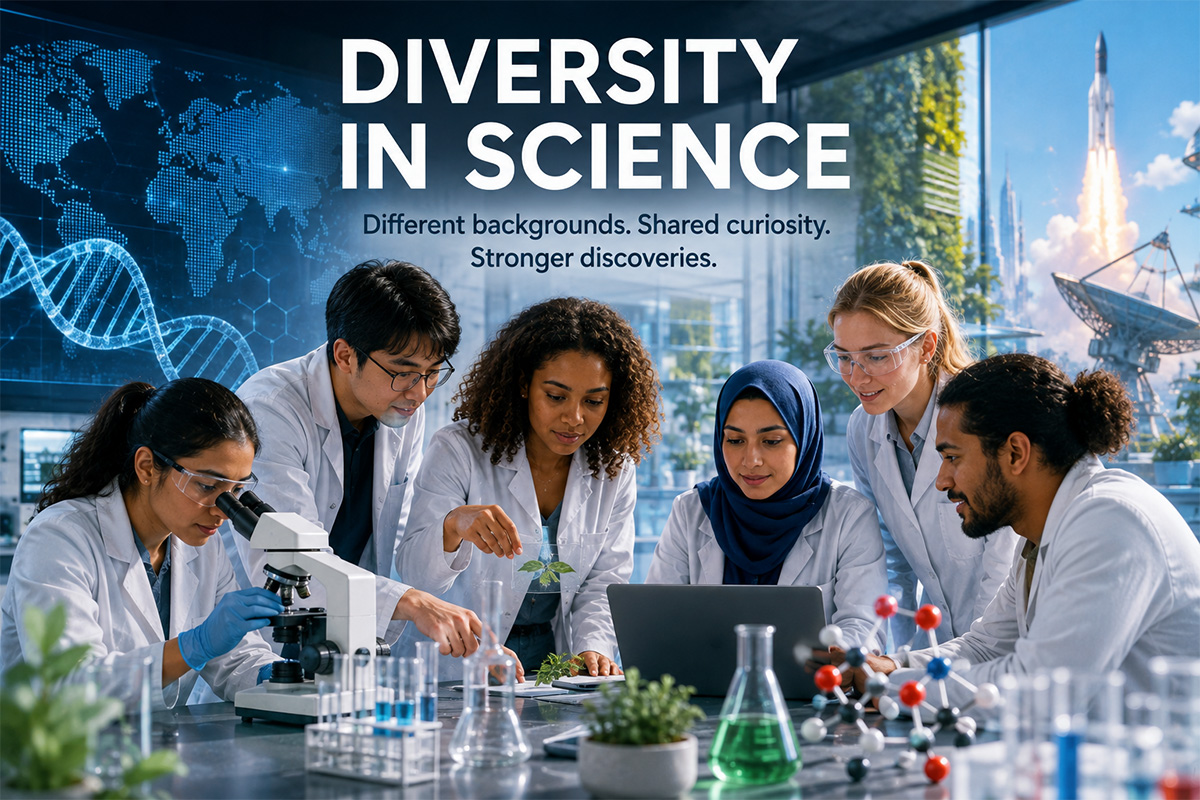
Science Is for Everyone
Look around your classroom, neighborhood, or community, and you’ll notice that everyone has different experiences, talents, cultures, interests, and ways of thinking. These differences help shape how people solve problems, ask questions, and understand the world. The same idea is true in science.
Some of the world’s greatest discoveries have come from people with very different backgrounds working together. Scientists, engineers, doctors, programmers, and inventors each bring unique knowledge and perspectives to the challenges they face. When people with different ideas collaborate, they often find creative solutions that a single person or group might never have imagined.
Diversity in science means encouraging people from all backgrounds, cultures, genders, abilities, ages, and life experiences to participate in scientific research, engineering, technology, and mathematics. It also means creating opportunities so that everyone who has an interest in science has a chance to learn, contribute, and succeed.
As our world becomes more connected, diversity is becoming one of the most important strengths of modern science.
What Does Diversity Mean?
Diversity includes many different kinds of differences.
People may come from different countries, cultures, languages, religions, neighborhoods, or economic backgrounds. They may have different abilities, learning styles, or personal experiences. Some may approach problems through mathematics, while others think visually or creatively.
In science, diversity is not simply about who is in the laboratory. It is also about bringing together different viewpoints and ways of solving problems. The more perspectives a team includes, the more ideas can be explored.
Why Different Perspectives Matter
Scientific discovery begins with asking questions. Different people often notice different things because of their experiences. One researcher may identify a problem that others have overlooked. Another may suggest a completely new way of solving it.
Imagine a team designing a new medical device. Engineers understand how the technology works. Doctors understand patient care. Nurses know how equipment is used in hospitals. Patients can explain what makes a device comfortable or difficult to use.
Each perspective improves the final product. This type of collaboration happens every day in modern science and engineering.
Better Science Through Teamwork
Many of today’s biggest scientific challenges cannot be solved by one person alone.
Developing new medicines requires biologists, chemists, doctors, engineers, computer scientists, and artificial intelligence researchers working together.
Space exploration depends on astronomers, physicists, robotics engineers, software developers, materials scientists, and medical researchers.
Climate scientists work with oceanographers, meteorologists, environmental engineers, ecologists, economists, and computer modelers.
These multidisciplinary teams often include people from many countries who share their knowledge and expertise.
The result is stronger research and more innovative solutions.
Diversity Drives Innovation
Innovation often happens when different ideas come together. Many inventions have been inspired by combining knowledge from completely different views.
When people with different skills collaborate, they often create technologies that would not exist otherwise. Many companies actively build diverse teams because studies have shown that teams with varied experiences often produce more creative ideas and solve complex problems more effectively.
Science Solves Global Problems
Many of today’s challenges affect people around the world. Climate change, clean energy, food production, disease outbreaks, access to clean water, cybersecurity, and space exploration all require international cooperation.
Scientists from different countries regularly share research, compare results, and work together on major projects. The International Space Station, for example, brought together astronauts, engineers, and scientists from multiple nations to conduct research in space. Large scientific experiments, medical studies, and environmental research often involve thousands of researchers working across many continents.
Global collaboration allows science to progress much faster than any one country could achieve alone.
Representation Inspires Future Scientists
Young people are often inspired when they see scientists who share similar backgrounds or experiences. Seeing successful researchers, engineers, doctors, inventors, and astronauts from many different communities helps students realize that science is open to everyone.
Role models encourage curiosity, confidence, and a sense of belonging. Many schools, universities, museums, and science organizations now work to introduce students to a wide variety of scientists whose contributions have shaped history and continue to advance science today.
Inspiration can come from anyone who demonstrates curiosity, perseverance, and a passion for discovery.
Technology Is Expanding Opportunities
Modern technology is making science more accessible than ever before. Students can attend online science classes, participate in virtual laboratories, and collaborate with classmates around the world.
Powerful computers, affordable electronics, robotics kits, and 3D printers allow students to explore engineering and scientific research from almost anywhere. Artificial intelligence can help explain difficult concepts, assist with programming, and analyze scientific data.
These technologies are opening new opportunities for students who may not have access to traditional laboratories.
Accessibility in Science
An important part of diversity is accessibility. Scientists and engineers are developing technologies that allow more people to participate in education and research. Speech recognition software helps people who have difficulty typing. Screen readers make digital information accessible to people with visual impairments.
Robotic prosthetic limbs, brain-computer interfaces, wearable technologies, and assistive communication devices are helping people overcome physical challenges. Laboratories, classrooms, and workplaces are also becoming more accessible through improved equipment and inclusive design. When barriers are reduced, more people can contribute their talents and ideas.
Challenges That Still Exist
Although science has become more inclusive over time, challenges remain.
Some students may have fewer educational resources or limited access to advanced science courses.
Financial barriers, geographic location, language differences, and unequal access to technology can also affect opportunities.
Scientists, educators, governments, businesses, and nonprofit organizations continue working to expand access to science education through scholarships, mentoring programs, online learning, community outreach, and improved educational resources.
Creating opportunities for more students benefits science as a whole.
Artificial Intelligence and the Future of Inclusion
Artificial intelligence may help make science even more accessible. AI tutors can provide personalized instruction that adapts to each student’s learning style. Language translation systems allow researchers from different countries to communicate more easily.
AI can also assist scientists by analyzing enormous amounts of research data, allowing researchers to focus more on creative problem-solving. At the same time, scientists work to ensure that AI systems are trained fairly and perform well for people with different backgrounds and needs.
Building responsible AI is itself an example of why diverse teams are valuable.
The Future of Science is Collaboration
The future of science will depend more than ever on collaboration. International cooperation will continue growing as scientists share information across the world almost instantly. As science becomes more global, diversity of ideas, experiences, and expertise will become even more important.
Science has always been driven by curiosity, creativity, and collaboration. Every new discovery builds on the work of countless people who bring different skills, ideas, and experiences to the table. When people from diverse backgrounds work together, they ask better questions, explore more possibilities, and develop solutions that can benefit communities around the world.