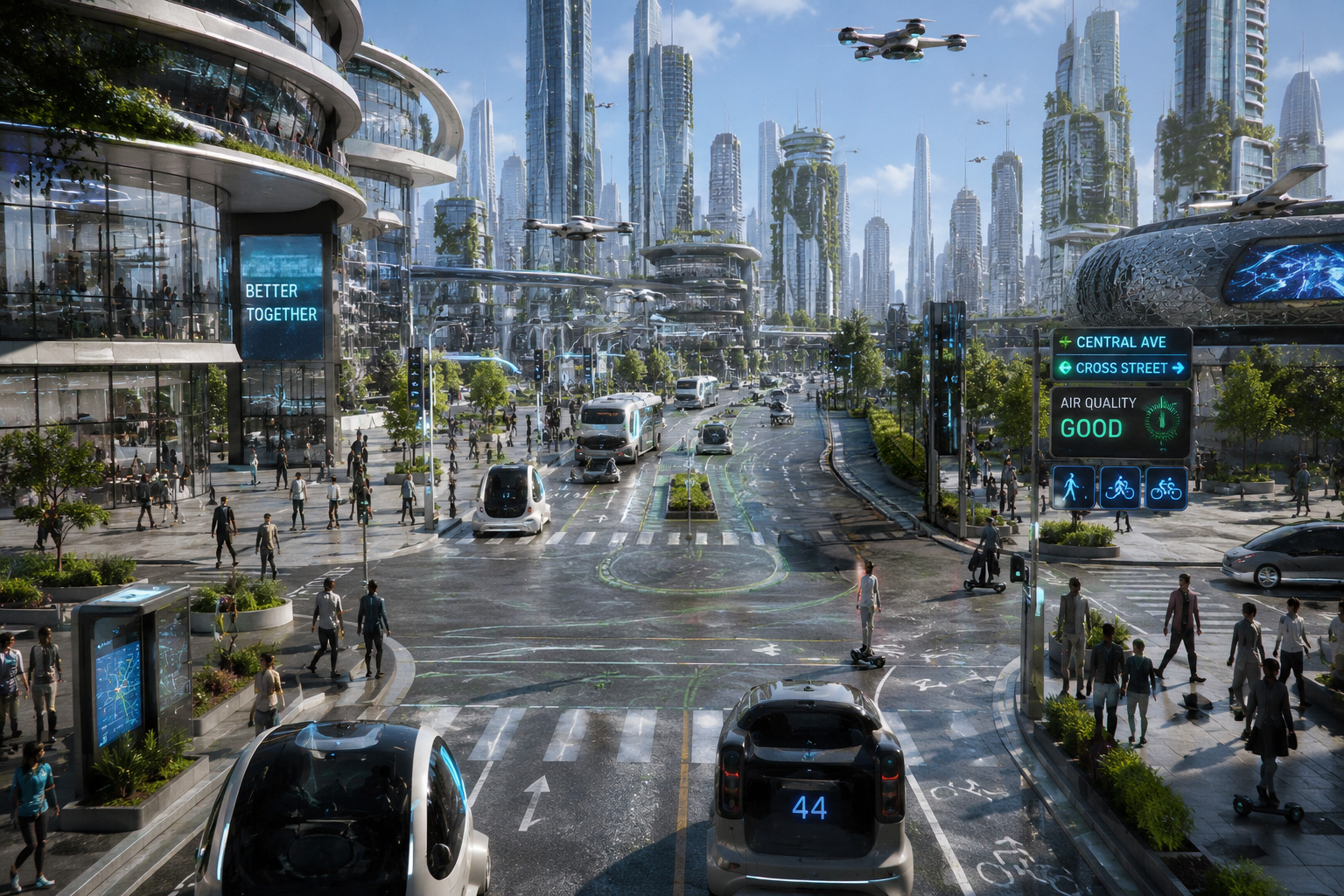
The Cities of Tomorrow
More than half of the world’s population already lives in cities, and that number is expected to continue growing over the coming decades. As cities become larger and more crowded, they will face increasing challenges such as traffic congestion, air pollution, housing shortages, energy demand, and climate change.
To solve these problems, engineers, architects, scientists, and city planners are developing future cities, sometimes called smart cities. These cities use advanced technologies such as artificial intelligence (AI), robotics, the Internet of Things (IoT), renewable energy, autonomous transportation, and advanced communication networks to improve everyday life.
Future cities are not just about building taller skyscrapers or adding more technology. Their goal is to create communities that are safer, healthier, cleaner, and more sustainable while improving the quality of life for everyone.
What Is a Smart City?
A smart city uses connected technologies to collect information, analyze it, and make better decisions automatically.
Throughout the city, thousands—or even millions—of sensors could monitor traffic, weather, air quality, water systems, electricity use, noise levels, and public transportation. This information is sent to powerful computers that use artificial intelligence to identify patterns and make real-time adjustments.
For example, traffic lights could automatically change to reduce congestion. Streetlights could brighten only when people are nearby, saving electricity. Water systems could detect leaks before pipes burst, and emergency services could respond more quickly by receiving live information from connected infrastructure.
Instead of operating as separate systems, many parts of the city would work together as one intelligent network.
Artificial Intelligence: The City’s Digital Brain
Artificial intelligence is expected to become one of the most important technologies in future cities.
Every day, cities generate enormous amounts of information. AI can analyze this data much faster than humans, helping city managers improve transportation, energy use, emergency response, and public services.
AI could predict traffic before it develops, allowing traffic signals to redirect vehicles automatically. It could monitor weather conditions, detect flooding risks, and help emergency responders prepare for natural disasters.
Artificial intelligence may also improve public transportation by predicting passenger demand and adjusting bus or train schedules automatically.
Sustainable Buildings
Buildings of the future may be far more environmentally friendly than today’s structures. Many future buildings may generate some or all of their own electricity using solar panels built into roofs, walls, or even windows.
Advanced insulation, smart heating and cooling systems, natural ventilation, and energy-efficient lighting could greatly reduce electricity consumption. Some buildings may include rooftop gardens, indoor farms, rainwater collection systems, and green walls covered with plants that improve air quality while helping regulate building temperatures.
Future construction materials may even repair small cracks automatically using self-healing concrete or other advanced materials, extending the life of buildings while reducing maintenance costs.
Renewable Energy
Future cities will likely rely much more heavily on renewable energy. Solar panels, wind turbines, geothermal energy, hydroelectric power, and advanced battery storage systems may work together to provide reliable electricity.
Instead of depending on one large power plant, cities may use smart electrical grids that distribute electricity from many different sources. Artificial intelligence could monitor energy demand throughout the city and automatically direct electricity where it is needed most. Homes with rooftop solar panels might even sell excess electricity back to the power grid, creating a more flexible and resilient energy system.
Cleaner energy could reduce air pollution while helping limit greenhouse gas emissions.
Transportation of the Future
Transportation may look very different in future cities. Electric vehicles are already becoming more common, and autonomous, or self-driving, vehicles continue to improve.
Future transportation systems may include self-driving cars, autonomous buses, delivery robots, electric bicycles, high-speed trains, and electric vertical takeoff and landing aircraft (eVTOLs), which are sometimes described as flying taxis.
Vehicles may communicate directly with one another and with roads, traffic signals, and parking systems. Artificial intelligence could coordinate traffic throughout the city, reducing congestion and improving safety.
Public transportation may become more convenient through AI systems that automatically adjust routes and schedules based on real-time passenger demand.
Robotics in the City
Robots are expected to play an increasingly important role in future cities.
Maintenance robots may inspect bridges, tunnels, pipelines, and power lines before problems become dangerous.
Autonomous cleaning robots could help keep streets, parks, and public buildings clean.
Delivery robots may transport groceries, meals, and packages across neighborhoods.
Emergency response robots could enter burning buildings, search disaster areas, or inspect hazardous chemical spills where it would be unsafe for people.
Connected Homes
Artificial intelligence could manage lighting, heating, cooling, security, and appliances automatically. Smart refrigerators may monitor food supplies and suggest recipes. Household robots could vacuum floors, mow lawns, or assist older adults with everyday activities. Water systems may detect leaks immediately, preventing damage and conserving water.
Connected homes could also communicate with the city’s electrical grid, charging electric vehicles when electricity is least expensive and reducing power use during periods of high demand.
Urban Farming
As cities grow larger, producing food closer to where people live may become increasingly important.
Future cities may include vertical farms inside buildings that grow vegetables using LED lighting and hydroponic systems instead of soil. Rooftop gardens, community greenhouses, and indoor agriculture could reduce transportation costs while providing fresh food year-round.
Artificial intelligence may monitor plant health, adjust lighting, and control watering automatically. Urban farming could improve food security while reducing the environmental impact of transporting food over long distances.
Digital Twins
One exciting future technology is the digital twin. A digital twin is a highly detailed virtual model of a real city.
It combines information from sensors, weather stations, traffic systems, and infrastructure to create a constantly updated digital version of the city. Engineers can test new roads, buildings, transportation systems, or emergency plans inside the digital model before making changes in the real world.
Digital twins may help cities reduce costs, improve safety, and respond more effectively to future challenges.
Challenges Facing Future Cities
Although smart cities offer many advantages, they also present important challenges.
Collecting information from millions of sensors raises questions about privacy. Cities must carefully protect personal information and ensure that technology respects individual rights.
Cybersecurity is another concern. Connected infrastructure must be protected from cyberattacks that could disrupt transportation, electricity, water systems, or emergency services.
Cost is also important. Building advanced infrastructure requires significant investment, and city leaders must ensure that new technologies benefit all residents rather than only certain neighborhoods.
Future cities should also remain inclusive and accessible for people of all ages and abilities.
How Future Cities Could Affect Society
Future cities could change daily life in many positive ways.
Cleaner transportation and renewable energy may reduce pollution and improve public health. Smarter infrastructure could reduce traffic, save energy, and make emergency services more effective.
Healthcare may become more preventive through wearable technology and remote monitoring. Education could become more personalized through artificial intelligence and immersive learning.
However, these technologies may also change employment as automation performs more routine tasks. Workers may need to learn new skills throughout their careers as technology continues evolving.
Privacy will become increasingly important as cities collect more information to improve services. Society will need clear rules about how personal data is collected, stored, and protected.
Ultimately, the success of future cities will depend not only on advanced technology but also on thoughtful planning, fairness, and public trust.
Future cities will likely be cleaner, smarter, and more connected than today’s urban environments. Artificial intelligence, robotics, renewable energy, wearable technology, autonomous transportation, and intelligent infrastructure have the potential to improve public safety, reduce pollution, conserve resources, and create healthier communities.