Transportation Is Changing
Transportation has always shaped society. Ships connected distant civilizations, railroads helped cities and industries grow, automobiles transformed where people could live and work, and airplanes made it possible to cross continents in hours. We may now be entering another major transportation revolution.
Electric vehicles, artificial intelligence, autonomous vehicles, drones, advanced trains, eVTOL aircraft, robotics, and clean-energy technologies are developing at the same time. Over the coming decades, these technologies could make transportation safer, cleaner, more accessible, and increasingly automated.
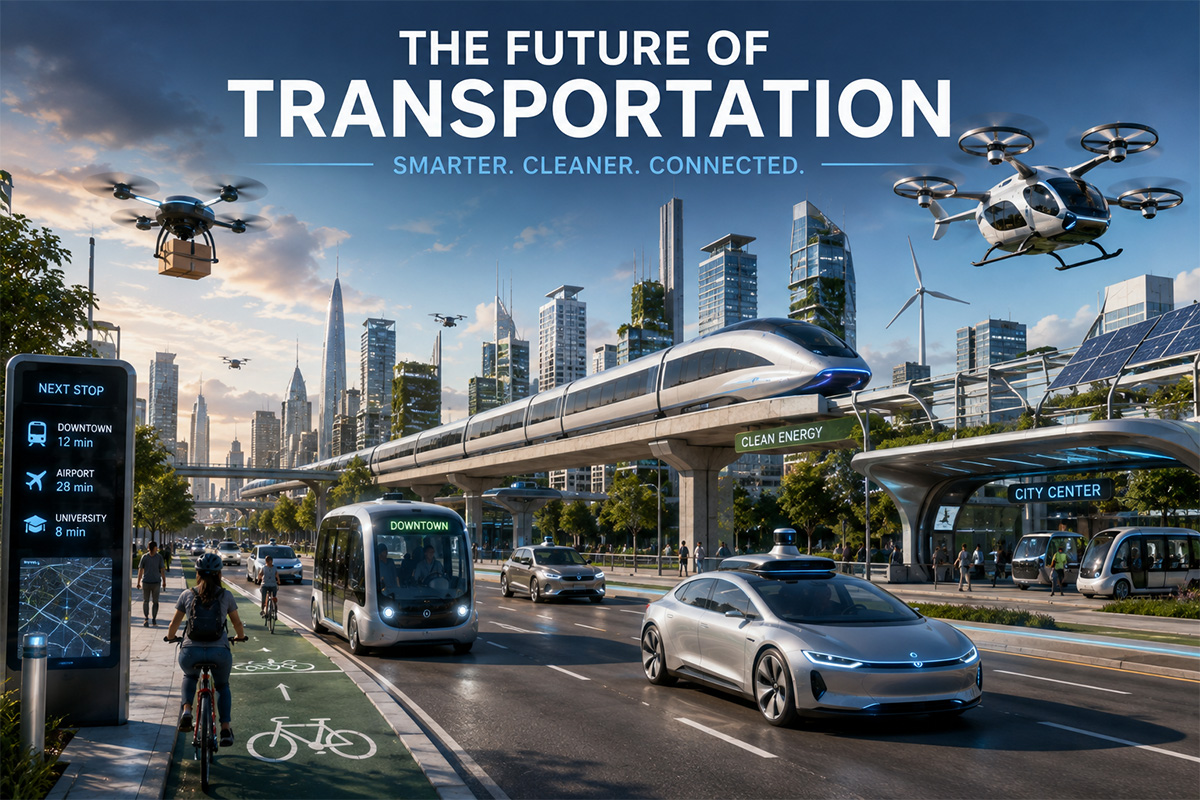
The biggest change may not be any single futuristic vehicle. Instead, cars, buses, trains, aircraft, bicycles, robots, and city infrastructure could become parts of one connected transportation network.
Electric Vehicles
One of the largest changes is already underway: transportation is becoming increasingly electric. Electric vehicles, or EVs, replace the gasoline engine with one or more electric motors powered by batteries. Electric motors have several advantages. They are highly efficient, produce strong torque from low speeds, require fewer moving parts than internal-combustion engines, and produce no exhaust emissions from the vehicle itself.
The battery remains one of the most important challenges. Today’s EVs commonly use lithium-ion batteries. Researchers are working on batteries that can store more energy, charge faster, last longer, cost less, and use materials that are easier to obtain and recycle.
Solid-state batteries are one possibility. They replace the liquid or gel electrolyte used in conventional lithium-ion batteries with a solid material. If successfully commercialized at large scale, some designs could potentially improve safety and energy density.
Battery technology will influence not only cars but also buses, trucks, motorcycles, ships, and eventually some aircraft.
Vehicles Become Computers on Wheels
Modern vehicles contain an enormous amount of electronics. Cameras, radar, ultrasonic sensors, GPS receivers, accelerometers, processors, and dozens of electronic control systems can monitor everything from tire pressure to the objects surrounding the vehicle. Future vehicles will become even more computerized.
Software could continuously improve vehicle performance, manage batteries, plan routes, monitor mechanical systems, and communicate with transportation infrastructure. Artificial intelligence may become an especially important part of the vehicle.
Instead of thinking about a future car as a machine containing a computer, it may be more accurate to think of it as a mobile computer that happens to transport people.
Self-Driving Cars
One of the most ambitious transportation technologies is the autonomous vehicle. A fully autonomous car would be capable of observing its environment, planning a route, making driving decisions, and controlling the vehicle without requiring a human driver under its intended operating conditions.
To accomplish this, autonomous vehicles can combine several types of sensors. Cameras recognize road markings, traffic lights, pedestrians, vehicles, and signs. Radar uses radio waves to determine the distance and speed of objects. Some vehicles also use LiDAR, which sends laser pulses into the environment and measures their reflections to create a detailed three-dimensional map.
GPS and digital maps help determine location, while onboard computers combine all this information to understand what is happening around the vehicle.
Artificial intelligence then helps decide what the vehicle should do next.
Why Full Autonomy Is Difficult
Driving is much more complicated than simply following a road. A human driver can encounter construction zones, emergency vehicles, animals, damaged traffic lights, unusual weather, cyclists, pedestrians, and countless unexpected situations. An autonomous vehicle must recognize these situations and make safe decisions quickly.
Weather presents another challenge. Heavy rain, snow, fog, dust, and bright sunlight can affect sensors. For these reasons, vehicle automation is developing in stages. Driver-assistance systems can already perform tasks such as adaptive cruise control, lane centering, and automatic emergency braking, while more advanced autonomous systems operate under limited conditions in some locations.
Creating vehicles that can safely drive almost anywhere a person can remains a major engineering challenge.
What Happens When Cars Drive Themselves?
If highly automated vehicles become widespread, their effect on society could be significant. Older adults and people who cannot drive could gain greater independence. A self-driving vehicle could transport someone to school, work, or a medical appointment without requiring that person to operate the car.
Road safety could potentially improve if automated systems eventually reduce crashes caused by distraction, fatigue, speeding, and impaired driving.
However, autonomous vehicles could also affect millions of jobs involving driving, including trucking, taxis, delivery services, and public transportation.
New jobs would likely emerge in software, robotics, fleet operations, cybersecurity, sensor technology, and vehicle maintenance.
As with earlier forms of automation, society would need to adapt.
Cars That Communicate
Future vehicles may not operate independently.
Vehicle-to-everything communication, often called V2X, is designed to allow vehicles to exchange information with other vehicles and transportation infrastructure.
Imagine a car approaching an intersection.
Before the driver can see anything unusual, the vehicle might receive a warning that another car has run a red light. A traffic signal could tell approaching vehicles when it will change, while road construction equipment could automatically warn cars about a closed lane.
Vehicles might also communicate with cyclists, pedestrians’ devices, parking systems, and emergency vehicles.
Transportation could gradually become a cooperative network where vehicles share information rather than simply reacting to what their own sensors can see.
Smarter Roads
The roads themselves could become more intelligent. Sensors embedded in or around roadways could monitor traffic, weather, pavement conditions, and accidents.
Traffic lights could automatically adjust their timing according to actual traffic rather than following fixed schedules. Digital signs could change speed limits when weather conditions become dangerous. Roads could also communicate information directly to vehicles, warning them about ice, construction, congestion, or accidents ahead.
Artificial intelligence could coordinate thousands of intersections throughout a city, helping traffic move more efficiently. The future of transportation may therefore depend as much on intelligent infrastructure as intelligent vehicles.
Public Transportation
Future transportation does not mean everyone will have a self-driving car. Buses, trains, subways, bicycles, and other shared transportation could become even more important as cities grow.
AI could analyze passenger demand and automatically adjust routes and schedules. Instead of a bus following exactly the same route every hour, smaller autonomous shuttles might change their routes depending on where passengers actually need transportation. A smartphone or wearable device could plan an entire journey involving several transportation methods.
For example, an app might direct someone to ride an electric bicycle for 5 minutes, board an autonomous shuttle, take a train across the city, and then walk the final few blocks. To the passenger, these different systems could feel like one transportation service.
High-Speed Rail
Rail transportation could also become faster and more advanced. High-speed electric trains already transport passengers between cities at hundreds of miles per hour in several parts of the world.
Future trains could become lighter, more energy-efficient, and increasingly automated. One advanced technology is magnetic levitation, or maglev. Instead of rolling on conventional wheels, a maglev train uses magnetic forces to lift and propel the train. Reducing physical contact can decrease friction and allow very high speeds.
High-speed rail could replace some short-distance airline flights, particularly between large cities where airports require significant travel and waiting time.
The greatest obstacles are often not the trains themselves but the enormous cost and complexity of constructing new rail infrastructure.
The Hyperloop Idea
Another proposed transportation system is the hyperloop. The concept involves passenger or cargo vehicles traveling through tubes with greatly reduced air pressure. With less air resistance, vehicles could theoretically travel at very high speeds while using relatively little energy once moving.
Magnetic levitation could further reduce friction. The physics behind low-pressure transportation is real, but creating a large, safe, affordable passenger network presents major engineering challenges.
Long tubes would need to maintain low pressure, withstand environmental conditions, handle emergency evacuations, and connect conveniently with cities.
Hyperloop technology remains experimental, and whether it becomes a practical transportation system is uncertain.
eVTOL Aircraft and Air Taxis
Future transportation could also expand vertically. Companies are developing electric vertical takeoff and landing aircraft, usually called eVTOLs.
Unlike conventional airplanes, eVTOL aircraft are designed to take off and land vertically, potentially allowing them to operate from relatively small landing areas.
Many designs use several electric motors and propellers. Multiple motors can provide precise control and, depending on the design, some redundancy if a component fails. Some eVTOLs are intended to operate as short-distance air taxis between airports, suburbs, and city centers.
Electric propulsion could make these aircraft quieter than conventional helicopters, although noise, safety, cost, air traffic management, battery performance, and regulations remain important challenges.
Flying taxis may become useful for certain routes, but they are unlikely to replace ordinary ground transportation for most people.
Delivery Drones
Drones may become a common part of transportation even if most people never ride in one. Small autonomous aircraft can potentially transport lightweight packages, food, medicines, and emergency supplies.
Drones are particularly useful when roads are slow or unavailable. A medical drone could carry blood or medicine to an isolated community. During a natural disaster, drones could deliver supplies when roads are blocked.
Future delivery networks could include automated distribution centers where robots load packages onto drones without human assistance.
However, large numbers of delivery drones would create challenges involving noise, privacy, weather, airspace management, and safety.
Robots on the Sidewalk
Not every delivery vehicle needs to fly. Small autonomous robots are already being tested for transporting food and packages along sidewalks and campuses. These robots use cameras, sensors, GPS, and artificial intelligence to navigate around people and obstacles.
Future neighborhoods could have fleets of electric delivery robots transporting groceries and packages over the final mile between a local distribution center and someone’s home. This could reduce the need for large delivery trucks to repeatedly travel through residential neighborhoods.
Robotic delivery could also become useful for older adults and people with limited mobility.
Autonomous Trucks
Long-distance trucking is another area where automation could have a major impact. Highways are more predictable than crowded city streets, making some highway driving potentially easier to automate.
Future autonomous trucks could transport cargo between distribution centers while human drivers handle more complicated local routes.
Electric trucks could reduce emissions, while hydrogen fuel cells may be useful for some long-distance or heavy-duty applications if suitable infrastructure and economics develop.
Automation could make shipping more efficient, but it could also significantly change the trucking profession.
Truck drivers perform more than steering, so the future may involve a mixture of automated highway driving and human supervision rather than the immediate disappearance of drivers.
Hydrogen Transportation
Batteries are not the only possible clean-energy technology for transportation. Hydrogen fuel cells combine hydrogen with oxygen in an electrochemical reaction that produces electricity, with water as the primary product at the vehicle.
Fuel cells can power electric motors just as batteries do. Hydrogen can be refueled quickly and may have advantages for some heavy vehicles where extremely large batteries would add considerable weight.
However, producing low-emission hydrogen, transporting it, storing it, and building fueling infrastructure are major challenges.
Future transportation will probably use different energy sources for different applications rather than relying on one solution for everything.
The Future of Aviation
Commercial airplanes are much more difficult to electrify than cars because aircraft must carry their energy source into the sky.
Batteries are heavy compared with aviation fuel for the amount of usable energy they store.
Small electric aircraft are already possible, and improved batteries could expand their capabilities.
Larger aircraft may eventually use sustainable aviation fuels, hydrogen, hybrid-electric systems, or other technologies to reduce emissions.
Aircraft could also become increasingly autonomous. AI systems may assist pilots with navigation, weather analysis, fuel efficiency, and emergency decision-making.
New aircraft shapes and lightweight composite materials could further reduce energy consumption.
Supersonic Travel
Supersonic passenger aircraft could also return. A supersonic airplane travels faster than the speed of sound. Earlier supersonic passenger aircraft demonstrated that extremely fast commercial travel was possible, but high operating costs, fuel consumption, and sonic booms limited its usefulness. Engineers are investigating quieter aerodynamic designs that could reduce the intensity of sonic booms.
If these technologies succeed and prove economically practical, future travelers might once again cross oceans much faster than today’s commercial airliners allow. However, reducing environmental impact will be an important part of making faster air travel practical.
Transportation Underground
When cities become crowded, one option is building transportation above the streets. Another is going underneath them. Future cities could expand underground transportation using automated subway systems and tunnels.
Electric autonomous vehicles traveling through dedicated tunnels would not encounter pedestrians, intersections, or ordinary surface traffic. Moving some transportation underground could free surface space for parks, bicycles, pedestrians, and housing.
Tunnels are expensive to construct, however, particularly in dense cities containing utilities, foundations, and existing subway systems. Advances in automated tunnel-boring technology could help reduce these costs.
Transportation on the Water
Future transportation will also include oceans and waterways. Cargo ships transport enormous quantities of goods around the world, making shipping an important target for cleaner technology. Future ships may use wind-assisted propulsion, batteries, hydrogen-derived fuels, fuel cells, or combinations of technologies to reduce fossil-fuel consumption.
Autonomous navigation could help ships select efficient routes and avoid hazards. Hydrofoils are another interesting technology. A hydrofoil uses underwater wings to lift much of a boat’s hull above the water as speed increases, reducing drag.
Electric hydrofoil boats could make some forms of water transportation quieter and more energy-efficient.
Personal Transportation
Not every future transportation technology will be large or complicated. Electric bicycles, scooters, and other small electric vehicles are already changing transportation in many cities. These vehicles require much less energy and space than automobiles.
Future versions could use lightweight materials, improved batteries, regenerative braking, collision-warning systems, and connected navigation. For short urban trips, a bicycle or lightweight electric vehicle may often be more efficient than moving a 4,000-pound (1,814-kilogram) automobile carrying a single person.
Future cities could therefore place greater emphasis on micromobility—small vehicles designed for short trips.
Transportation for People with Disabilities
One of the most important benefits of future transportation could be greater independence. Autonomous vehicles could provide transportation for people who cannot drive because of visual, physical, or other disabilities. Wheelchair-accessible autonomous shuttles could automatically adjust ramps and seating.
Navigation systems could provide spoken, visual, or haptic directions depending on a passenger’s needs. Robotic systems might assist passengers entering and leaving vehicles.
Designing accessibility into transportation from the beginning could make future mobility more useful for everyone.
Transportation and Climate Change
Transportation is a major source of greenhouse gas emissions, which makes cleaner transportation an important part of addressing climate change.
Electrification can reduce direct emissions from cars, buses, and other vehicles, especially as electrical grids use more renewable and low-carbon energy.
However, simply replacing every gasoline car with an electric car will not solve every transportation problem.
Vehicles still require roads, parking spaces, raw materials, and energy.
Efficient public transportation, walkable communities, bicycles, smaller vehicles, and better city planning can reduce the amount of energy required to move people.
The cleanest trip can sometimes be the one that requires the least transportation.
Will We Still Own Cars?
For more than a century, personal car ownership has shaped many communities. Autonomous transportation could change that. If an inexpensive self-driving vehicle could arrive within a few minutes whenever needed, some people might decide that owning a car is unnecessary.
A shared autonomous vehicle could transport one passenger, drop that person off, and immediately serve someone else. This could reduce the number of vehicles that spend most of their time parked. On the other hand, people value the convenience, privacy, and freedom of owning personal vehicles, particularly outside dense cities.
The future will probably include both ownership and shared transportation, with the balance varying between communities.
What Happens to Parking Lots?
A change in car ownership could even transform cities physically.
Cars spend most of their lives parked. As a result, enormous amounts of valuable urban land are devoted to parking spaces and garages.
If future transportation requires fewer parked vehicles, some of this land could be converted into housing, parks, businesses, bicycle paths, or pedestrian areas.
Buildings might also require fewer parking garages.
Transportation technology could therefore influence architecture and city design in ways that have little to do with the vehicles themselves.
Privacy and Future Transportation
Highly connected transportation creates important privacy questions. A smartphone may know where you are, but an autonomous transportation network could potentially know where you travel every day. Vehicles could collect location information, camera footage, passenger information, payment records, and driving data.
Driver-monitoring systems might even observe facial expressions or eye movements to determine whether someone is paying attention. This information can improve safety and convenience, but it must also be protected.
Future transportation systems will need strong cybersecurity, encryption, and clear rules about how personal information is stored and used.
Making Transportation Available to Everyone
A transportation system is valuable only if people can use it.
Advanced transportation technologies could improve access to schools, jobs, healthcare, and other opportunities, particularly for people who currently have limited transportation choices.
But new systems could also increase inequality if they are too expensive or available only in wealthy communities.
Rural communities present different challenges from large cities. A subway may work well in a dense urban area but make little sense in a small town.
Future transportation will need many different solutions designed around the needs of individual communities.
Technology should make mobility more accessible rather than creating another digital divide.
The City of 2100
Imagine traveling through a city near the end of this century.
Electric autonomous vehicles quietly move through intersections coordinated by AI. High-speed trains connect nearby cities, while small autonomous shuttles transport passengers through neighborhoods.
Electric bicycles and scooters travel along protected paths separated from larger vehicles.
Delivery robots move packages along sidewalks while drones transport urgent medical supplies overhead.
Some buildings contain eVTOL landing areas, while underground trains move large numbers of passengers beneath the city.
Traffic lights communicate directly with vehicles, and renewable electricity powers much of the transportation network.
Whether cities actually look like this in 2100 is impossible to know.
But many of the technologies required to begin building such a system are already being developed today.
Not every futuristic idea will succeed. Some technologies will prove too expensive, inefficient, unsafe, or impractical. Others may develop in ways we do not yet expect.
The biggest transformation may ultimately be how society thinks about transportation itself.
For much of the last century, transportation has centered on owning a vehicle. In the future, it may increasingly become a connected service that surrounds us—available when we need it and coordinated automatically.