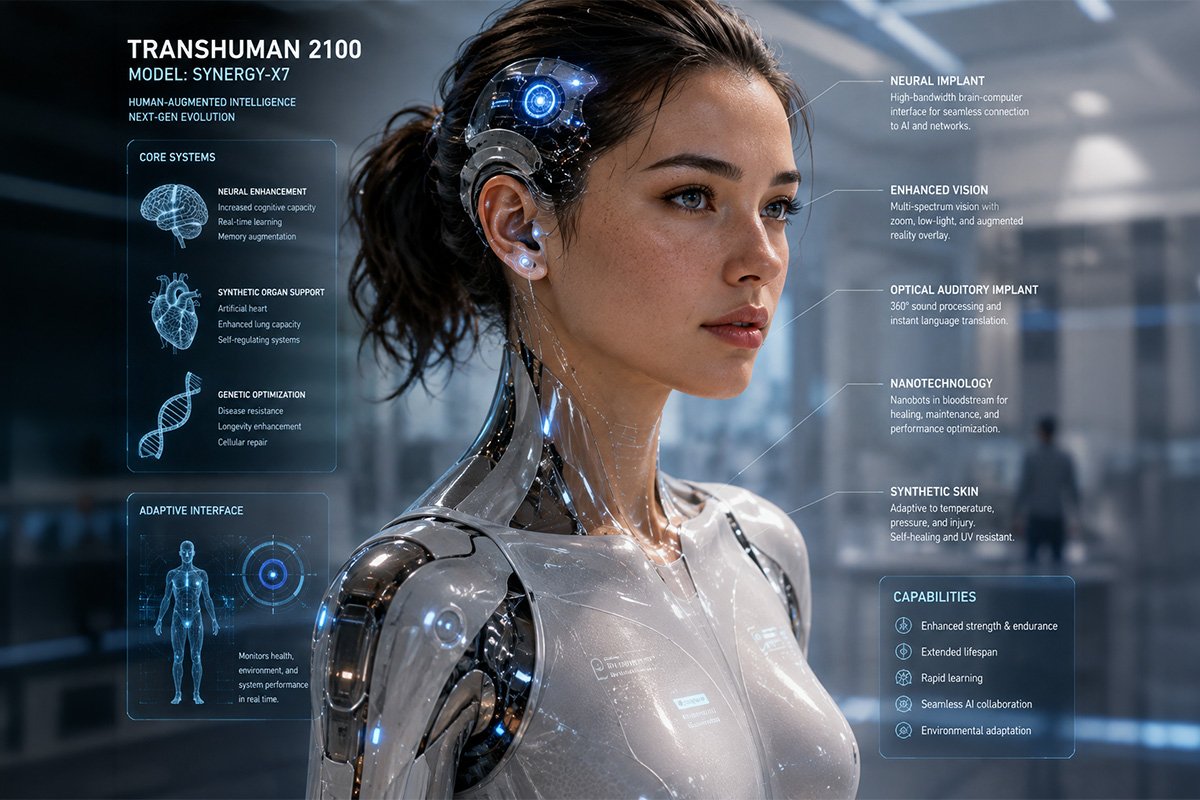
What Is Transhumanism?
Humans have always used technology to overcome our natural limitations. Eyeglasses improve vision, medicines help us fight disease, airplanes allow us to fly, and smartphones give us almost instant access to information from around the world.
But what happens when technology begins changing the human body and brain themselves? Could technology change what it means to be human?
Transhumanism is a philosophical and technological movement based on the idea that science and technology could be used to improve human physical and mental abilities and reduce limitations such as disease, disability, aging, and perhaps eventually some of the biological limits of the human body.
Some of the technologies associated with transhumanism already exist. Advanced prosthetic limbs can respond to electrical signals from muscles. Cochlear implants can provide a sense of sound to some people with severe hearing loss. Brain-computer interfaces can allow some people with paralysis to control computers using neural activity.
Other transhumanist ideas, such as dramatically increasing human intelligence, replacing most of the body with artificial components, or transferring a human mind into a computer, remain speculative.
Transhumanism therefore covers everything from technologies beginning to appear in medicine today to possibilities that may remain science fiction for a very long time.
From Treatment to Enhancement
An important idea in transhumanism is the difference between treatment and enhancement.
Medicine traditionally tries to restore normal function. If someone loses a leg, for example, a prosthetic leg can help restore mobility.
But imagine a future artificial leg that becomes stronger, faster, and more durable than a biological leg. Should someone without an injury be allowed to replace a healthy limb to gain those abilities?
The same question could apply to eyesight, hearing, memory, strength, intelligence, and lifespan.
At some point, technology could cross a blurry boundary between repairing the human body and improving it beyond its ordinary biological abilities.
Where that boundary should be is one of the central questions surrounding transhumanism.
Advanced Prosthetic Limbs
Prosthetic technology provides an early example of how humans and machines can become connected. Traditional prosthetic limbs primarily replace the physical shape of a missing arm or leg. Advanced bionic prostheses use motors, sensors, microprocessors, and sophisticated control software to produce much more natural movement.
Some prosthetic hands can detect electrical signals produced when muscles contract. A computer interprets these signals and determines how the user intends to move the artificial hand.
Researchers are also developing systems that communicate with nerves, potentially allowing information to travel in both directions. The person controls the prosthesis, while sensors in the artificial limb provide information that may help create a limited sense of touch.
Future prostheses could eventually provide capabilities that biological limbs do not naturally possess.
Artificial Organs
Transhumanism does not necessarily mean replacing the entire human body with machinery. Individual biological organs could increasingly be supported or replaced by technology.
Artificial hearts and mechanical heart-assistance systems already help some patients whose hearts cannot pump enough blood. Researchers are developing more sophisticated artificial organs as well as biological replacements created through regenerative medicine, stem cells, and tissue engineering.
Future artificial organs might eventually last longer and perform better than today’s replacements. If scientists could reliably replace damaged hearts, kidneys, livers, lungs, or other organs, some diseases that are currently life-threatening could become manageable engineering problems.
Brain-Computer Interfaces
Perhaps no technology is more closely associated with transhumanism than the brain-computer interface, or BCI.
A BCI creates a communication pathway between the nervous system and an external device.
Researchers can record patterns of electrical activity produced by neurons and use computers to interpret some of those patterns. Experimental systems have allowed people with paralysis to move computer cursors, operate robotic devices, and communicate using neural activity.
The medical possibilities are significant. Future BCIs could help restore communication, movement, hearing, or vision for people affected by injuries and neurological conditions.
But transhumanists imagine going much further. Someday, brain interfaces might potentially allow people to interact with computers more directly, although the abilities of current systems are far more limited than fictional portrayals of telepathic communication with machines.
Could We Improve Human Memory?
Human memory is remarkable but imperfect. We forget names, lose details over time, and sometimes remember events incorrectly. Future brain-computer interfaces could potentially assist memory by interacting with brain regions involved in storing and retrieving information.
A more practical form of technological memory enhancement is already happening outside our bodies. Smartphones and computers remember phone numbers, photographs, appointments, documents, and enormous amounts of information for us.
Artificial intelligence could take this idea further by creating highly personalized digital assistants capable of organizing a lifetime of information. Instead of biologically increasing memory, technology might become an external extension of it.
Artificial Intelligence and Human Intelligence
Artificial intelligence introduces another possibility: instead of making the biological brain dramatically smarter, humans could work increasingly closely with intelligent machines. We already use calculators to extend our mathematical abilities, search engines to access information, and navigation systems to help us find our way.
Future AI assistants could help people analyze complicated information, learn new subjects, write software, translate languages, design products, or conduct scientific research. Eventually, the distinction between what a person knows and what their AI assistant can instantly provide may become less important.
This could create a type of combined intelligence, where humans contribute judgment, experience, creativity, and goals while machines provide computation, memory, and rapid data analysis.
Enhanced Vision and Hearing
Technology already modifies human senses. Cochlear implants convert sound into electrical signals that stimulate the auditory nerve, helping some people with severe hearing loss perceive sound.
Future visual implants may help restore limited forms of vision to some people affected by blindness. Farther into the future, sensory technology could potentially expand perception beyond ordinary human abilities.
A visual system might detect infrared wavelengths that humans normally cannot see. An augmented hearing device could selectively amplify a conversation while reducing background noise.
The purpose could eventually shift from correcting sensory loss to expanding the range of information humans can perceive.
Genetic Engineering
Not every human enhancement would involve electronics. Biotechnology could potentially change human abilities at the genetic level.
Technologies such as CRISPR allow scientists to make targeted changes to DNA. Gene-editing research is already contributing to treatments for certain diseases. Using genetic technologies to treat disease is very different from using them to enhance healthy people.
Future scientists might theoretically investigate genetic changes related to muscle development, metabolism, or other characteristics. Enhancing complicated traits such as intelligence would be far more difficult because they involve interactions among many genes, development, health, education, and environment.
Human genetic enhancement would also create major safety and ethical concerns, particularly if changes could be inherited by future generations.
Transhumanism and Aging
One of transhumanism’s most ambitious goals is overcoming some of the effects of aging. Aging is an extremely complicated biological process involving changes in cells, DNA, proteins, metabolism, immune function, and tissues throughout the body. Scientists are investigating these processes in an effort to extend healthspan, the portion of life spent in relatively good health.
Regenerative medicine might someday repair damaged tissues. Artificial organs could replace failing biological ones. Gene therapies could potentially treat some age-related conditions, while AI-assisted medicine could detect diseases earlier. Whether humans will ever be able to dramatically extend their maximum lifespan remains uncertain.
Even modest increases in healthy lifespan, however, could have enormous effects on society.
What If People Lived Much Longer?
Suppose future medicine allowed large numbers of people to remain healthy for 100 years or considerably longer.
Many familiar parts of society could change. People might have several different careers rather than one primary career. Education could become something people return to repeatedly throughout life as technologies and professions change.
Retirement might happen much later, and relationships between generations could become very different if five or six generations of a family were alive simultaneously. Longer lives could also place pressure on housing, natural resources, healthcare systems, employment, and retirement programs.
Longevity would therefore be more than a medical breakthrough. It could transform the structure of society.
Mind Uploading
One of the most extreme ideas associated with transhumanism is mind uploading, sometimes called whole-brain emulation. The basic idea is that a future technology might scan the structure and activity of a human brain in extraordinary detail and create a computer model that reproduces the person’s memories, personality, and mental processes.
This remains entirely speculative.
The human brain contains roughly 86 billion neurons connected through an enormously complicated network. Scientists still do not completely understand how this activity produces memory, personality, consciousness, and our sense of being ourselves.
Even if a computer could someday reproduce someone’s brain perfectly, a difficult philosophical question would remain. Would the digital version actually be you, or would it simply be a copy that believes it is you?
Science currently has no answer.
Could Humans Become Part Machine?
The popular image of a transhuman is often a person covered in robotic parts, but the real future could be much less obvious. Someone might have an artificial heart, a neural implant, genetically modified cells, augmented-reality contact lenses, and microscopic medical sensors inside their body while appearing completely ordinary.
The boundary between human and machine may therefore become increasingly difficult to define. In fact, that process has arguably already begun. Millions of people depend on pacemakers, cochlear implants, artificial joints, prosthetic limbs, and other technologies incorporated into or closely connected with their bodies.
Future technologies could simply make this relationship much deeper.
Who Gets Access to Human Enhancement?
Perhaps the biggest social question surrounding transhumanism is access. Advanced technologies are often expensive when first introduced. If future enhancements improve health, lifespan, strength, or mental abilities, people who can afford them could potentially gain advantages unavailable to others. This could create a new type of technological inequality.
Society already debates unequal access to education, healthcare, and technology. Human enhancement could make these questions much more complicated. If enhancement technologies become possible, deciding how they are distributed could be almost as important as inventing them.
Would Enhancement Become Expected?
Another issue is choice. Suppose a technology could safely improve memory by 20 percent. Nobody might be required to use it. Someone who chooses not to use the technology could be placed at a disadvantage. Employers might eventually prefer enhanced workers, and athletes might feel pressured to adopt technologies simply to remain competitive.
Something that begins as an optional enhancement could gradually become socially expected. Protecting the right to remain unenhanced could therefore become an important issue.
Sports in a Transhuman Future
Sports could face particularly difficult questions. Advanced prostheses, exoskeletons, genetic technologies, and other enhancements may eventually improve human performance. Sports organizations would have to decide which technologies are considered medical assistance and which provide an unfair advantage.
Entirely new sports could also develop specifically for enhanced humans. Just as automobile racing celebrates machines and human skill working together, future competitions might allow advanced prosthetics, powered exoskeletons, or augmented-reality systems.
Instead of trying to keep technology out of every sport, society might create new categories where technological enhancement is part of the competition.
Transhumanism and Identity
Human enhancement also raises a deeper question: What makes us human? Is it our biological bodies? Our DNA? Our brains? Our memories? Our relationships with other people? Replacing a hip joint does not make someone less human. Neither does wearing glasses or having a pacemaker. But what if most organs could eventually be replaced? What if someone had artificial senses or a brain connected continuously to AI?
There may never be a precise point where a person becomes “transhuman.”
Instead, humans may gradually incorporate more technology into their lives and bodies, forcing each generation to reconsider where the boundaries should be.
Possible Benefits to Society
Transhumanist technologies could provide enormous benefits.
People with paralysis might regain movement or communication. Artificial organs could save patients who would otherwise die waiting for transplants.
Advanced prostheses could restore independence after injuries. Genetic medicine could prevent or treat serious diseases.
Brain-computer interfaces could improve communication for people who cannot speak, while sensory technologies might restore hearing or vision.
Regenerative medicine could repair damaged tissues, and longevity research might allow people to remain healthier as they grow older.
Many technologies associated with transhumanism could therefore begin not as enhancements for healthy people but as medical tools that improve quality of life.
Risks and Challenges
Human enhancement also carries serious risks.
Implants could fail. Gene editing could have unintended biological consequences. Connected medical devices could be vulnerable to cyberattacks.
Long-term effects may not become apparent for years.
There are also social risks involving inequality, discrimination, privacy, and pressure to adopt enhancements.
Governments and medical organizations will need to decide which technologies require regulation and how their safety should be evaluated.
These decisions will become increasingly complicated when a technology is not treating an illness but enhancing an otherwise healthy person.
Transhumanism asks one of the most interesting questions in science and technology:
If we gain the ability to change ourselves, how far should we go?
Technology has always extended human abilities. Cars allow us to move faster, telescopes let us see across the universe, computers expand our ability to calculate, and the Internet gives us access to more information than any individual could possibly remember.
Future technology may bring those capabilities much closer to—or even inside—the human body.
Advanced prostheses could become better than the biological parts they replace. Brain-computer interfaces could create new ways to communicate with machines. Biotechnology might prevent diseases, while regenerative medicine could repair damaged tissues and organs.
Some of these technologies could dramatically improve human life. They could also create new questions about privacy, fairness, identity, safety, and equality.