The Future of Physics
Physics is the science and study of how the universe works. Matter, motion, energy, space and time, are some areas of research in physics, although the boundaries of physics are not rigidly defined. Theoretical breakthroughs in physics could make significant contributions to many future technologies.
At its core, physics seeks to understand and explain the nature of energy, matter, and their interactions. Physics has birthed countless inventions that power our modern world. From the electricity lighting your home, a product of electromagnetism, to the GPS guiding your car, a marvel of relativity, physics is woven into the fabric of our daily routines. Beyond immediate conveniences, physics underpins technological breakthroughs that have revolutionizes industries. Physics is not just a collection of complex equations; it's the invisible thread weaving through our lives, shaping our present and holding the key to a brighter future.
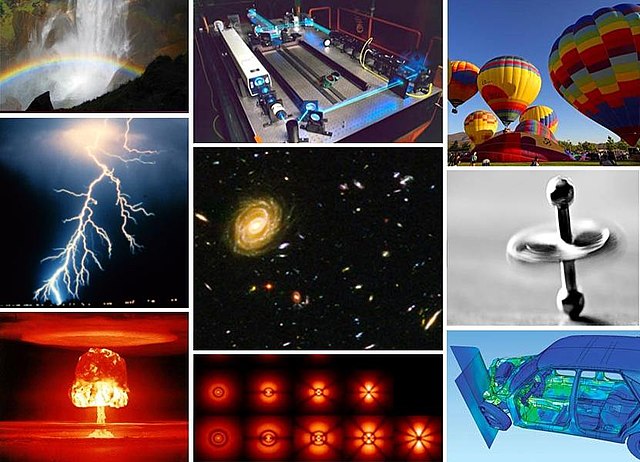
Collage image from Wikimedia Commons
Large Hadron Collider
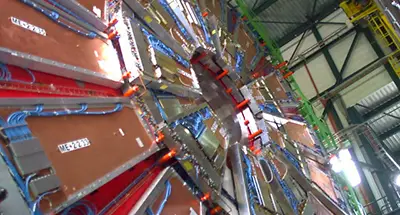
The Large Hadron Collider (LHC) is the world's largest and highest-energy particle accelerator complex, intended to collide opposing beams of protons or lead, two of several types of hadrons, at up to 99.99 percent the speed of light.
The LHC was built by the European Organization for Nuclear Research (CERN), and lies underneath the Franco-Swiss border between the Jura Mountains and the Alps near Geneva, Switzerland. It is funded by and built in collaboration with over 10,000 scientists and engineers from over 100 countries as well as hundreds of universities and laboratories with the intention of testing various predictions of high-energy physics, including the existence of the hypothesized Higgs boson.
Large Hadron Collider Resources
Safety of particle collisions at the Large Hadron Collider
Large Hadron Collider image from Wikimedia Commons

Invisibility Cloak

Invisibility cloaks might conjure images of disappearing wizards, but the science behind them focuses on bending, not erasing, light. Metamaterials are special materials that are engineered with structures that possess unique properties. By carefully designing their structure, scientists can manipulate how light interacts with them. Some metamaterials can bend light around an object, effectively creating a cloaking effect.
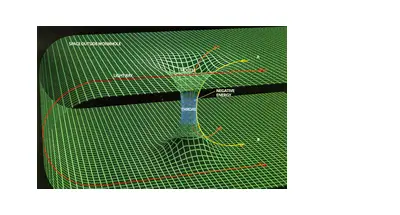
NASA's Recipe for a Wormhole:
First, collect a whole bunch of super-dense matter, such as matter from a neutron star. Enough to construct a ring the size of the Earth's orbit around the Sun. Then build another ring where you want the other end of your wormhole. Next, charge 'em up to some incredible voltage, and spin them up to near the speed of light -- both of them.
Step through worm hole. Adjust your watch if necessary as you may have arrived before you left.
Disclaimer: FutureForAll.org is not responsible for the destruction of any universe or galaxies therein.
Find out more at NASA
Physics Articles, Videos, and Web Sites
-
I search the internet daily for new articles from around the world that interest me or I think will interest you. My hope is that it saves you time or helps students with their assignments. Listed by most recent first. Hit NEXT button for more articles
-
Will new physics affect our Universe’s far future? from Big Think
-
MIT physicists snap the first images of free-range atoms from MIT News
-
The cat that wouldn’t die from Aeon
-
Challenging the Big Bang: A Multi-Singularity Origin for the Universe from AZoQuantum
-
The stagnation of physics from Aeon
-
Ghazal Geshnizjani: Exploring the cosmos through curiosity video
-
Scientists are no longer sure the Universe began with a bang from Aeon Essays
-
String theory is not dead from Knowable Magazine
-
What is dark matter? video
-
There's a Particle Accelerator at the Center of the Milky Way from Universe Today
-
Unleashing Quantum’s Potential from Center for Strategic and International Studies
-
Cosmology Is at a Tipping Point—We May Be on the Verge of Discovering New Physics from Singularity Hub
-
Researchers Remind Us Why Quantum Physics Is Just So Freaking Cool from UNLV
-
Quantum materials: Theoretical, experimental and computational physicists develop the technology of the future from BingUNews
-
Tiny, entangled universes that form or fizzle out – a theory of the quantum multiverse from Aeon
-
A Superconducting Device May Twist Heisenberg’s Uncertainty Principle from Popular Mechanics
-
Physicists Capture First-Ever Image of an Electron Crystal from Gizmodo
-
Science Simplified: What Is Quantum Mechanics? from SciTechDaily
-
Gravity Experiments on the Kitchen Table: Why a Tiny, Tiny Measurement May Be a Big Leap Forward for Physics from Singularity Hub
-
UO researcher brings the atomic world into focus using physics from University of Oregon
-
Physicists Measure Gravity of Smallest Mass Yet from Gizmodo
-
Massive Caverns Excavated for New Particle Accelerator in South Dakota from Gizmodo
-
ESA embarks on world-first mission to detect ripples in the fabric of space-time from TNW
-
Physicists Just Learned Something Major About the Proton from Gizmodo
-
What does the center of a black hole look like? from Big Think
-
Why Quantum Mechanics Defies Physics from Universe Today
-
Physicists Hunt Dark Photons as Large Hadron Collider Gets More Powerful from Gizmodo
-
World first quantum entanglement of single molecules from Cosmos
-
Physicists Designed an Experiment to Turn Light Into Matter from Gizmodo
-
Singularities don’t exist, claims black hole pioneer Roy Kerr from Big Think
-
‘Doughnut’ beams help physicists see incredibly small objects from University of Colorado Boulder
-
11 mind-boggling facts about time from BBC Future
-
Google Researchers Unveil Unique Form of Quantum Teleportation from SciTechDaily
-
3 Questions: A bigger, better space-ripple detector from MIT News
-
Scientists Have Determined How to Travel Back in Time With a Ring Wormhole from Popular Mechanics
-
There’s a striking link between quantum and astronomic scales. What could it mean? from Aeon
-
Untangling entanglement from Aeon
-
A new frontier in fundamental physics as quantum phase created by frustrating electrons from Cosmos
-
Researchers Directly Observe the Signatures of Electron Orbitals from AZoNano
-
Quantum physics proposes a new way to study biology – and the results could revolutionize our understanding of how life works from The Conversation
-
Entangled light source is fully on-chip from Physics World
-
Breaking Binary: Physicists Fully Entangle Two Quantum Digits from SciTechDaily
-
Scientists Create a Longer-Lasting Exciton that May Open New Possibilities in Quantum Information Science from Berkeley Lab
-
World-First Experimental Wormhole from SciTechDaily
-
Life: modern physics can’t explain it – but our new theory, which says time is fundamental, might from The Conversation
-
The Multiverse: Our Universe Is Suspiciously Unlikely to Exist—Unless It Is One of Many from Singularity Hub
-
Famous double-slit experiment recreated in fourth dimension by physicists from The Conversation
-
Physicists Create Photonic Time Crystal That Amplifies Light from Gizmodo
-
This Mirror Reverses How Light Travels in Time from IEEE Spectrum
-
Why does time change when traveling close to the speed of light? A physicist explains from The Conversation
-
Scientists demonstrate time reflection of electromagnetic waves in a groundbreaking experiment from ScienceDaily
-
In a First, Scientists Used a Lightsaber-like Technique to Play Catch With Atoms from Inverse
-
It’s a weird, weird quantum world from MIT News
-
Scientists Found an Entirely New Way of Measuring Time from Science Alert
-
Why aren’t our everyday lives as ‘spooky’ as the quantum world? from Aeon
-
Black holes may be the source of mysterious dark energy that makes up most of the universe from The Conversation
-
Physicists just discovered a new type of quantum entanglement from ZME Science
-
Are black holes time machines? Yes, but there’s a catch from The Conversation
-
Did Physicists Open a Portal to Extra Time Dimension, as Claimed? from Mind Matters
-
How many dimensions are there, and what do they do to reality? from Aeon Essays
-
Using quantum mechanics to see objects without looking at them from Tech Explorist
-
The tangled tale of how physicists built a groundbreaking wormhole in a lab from Aeon
-
Did physicists make a wormhole in the lab? Not quite, but a new experiment hints at the future of quantum simulations from The Conversation
-
The truth about wormholes and quantum computers from Big Think
-
There must be a singularity at each black hole’s center from Big Think
-
Is reality a simulation? A physicist explains how the truth may be revealed from Inverse
-
Lab-grown black hole may prove Stephen Hawking's most challenging theory right from Live Science
-
Powerful linear accelerator begins smashing atoms from The Conversation
-
Physicists shed new light on unanswered questions about glass-liquid transition from Nanowerk
-
In a world first, researchers combine two of the 'spookiest' features of quantum mechanics from Interesting Engineering
-
What is quantum entanglement? A physicist explains the science of Einstein’s ‘spooky action at a distance’ from The Conversation
-
Physicists Successfully Create a New Type of Quasiparticle from SciTechDaily
-
The fundamental problem with gravity and quantum physics from Big Think
-
Are black holes wormholes? from Live Science
-
The Trouble With The Big Bang from Nautilus
-
An interstellar voyage explores the paradox of twins separated by light years from Aeon
-
This Australian experiment is on the hunt for an elusive particle that could help unlock the mystery of dark matter from The Conversation
-
New Phase of Matter Physics Girl video
-
What are wormholes? An astrophysicist explains these shortcuts through space-time from The Conversation
-
What is Gravity? Wondrium Perspectives video
-
Record distance for quantum entanglement set for atoms 20 miles apart from TweakTown
-
LHC Scientists Find Three Exotic Particles — and Start Hunting for More from Universe Today